
Recall.ai vs Nylas Notetaker: API Comparison
See how Recall.ai vs Nylas Notetaker compare on platforms, real-time media, calendar sync, and price, plus where MeetStream fits at $0.35 per hour.

For developers building on top of meetings, the choice between Recall.ai and Nylas Notetaker comes down to a design philosophy. Recall.ai is a standalone bot infrastructure API for broad platform coverage, while Nylas Notetaker is a feature of the Nylas communications platform, tightly integrated with its calendar sync. For teams that need more than passive recording, a third option, MeetStream, provides agent-first voice infrastructure for meetings, where bots can join, hear, speak, and act in real time.
This comparison covers the differences in platform support, real-time media access, calendar integration, and security. We will look at where each API is a better fit and how MeetStream’s focus on interactive agents and per-participant media streams presents a different approach for developers building live meeting experiences.
Two Different Design Philosophies
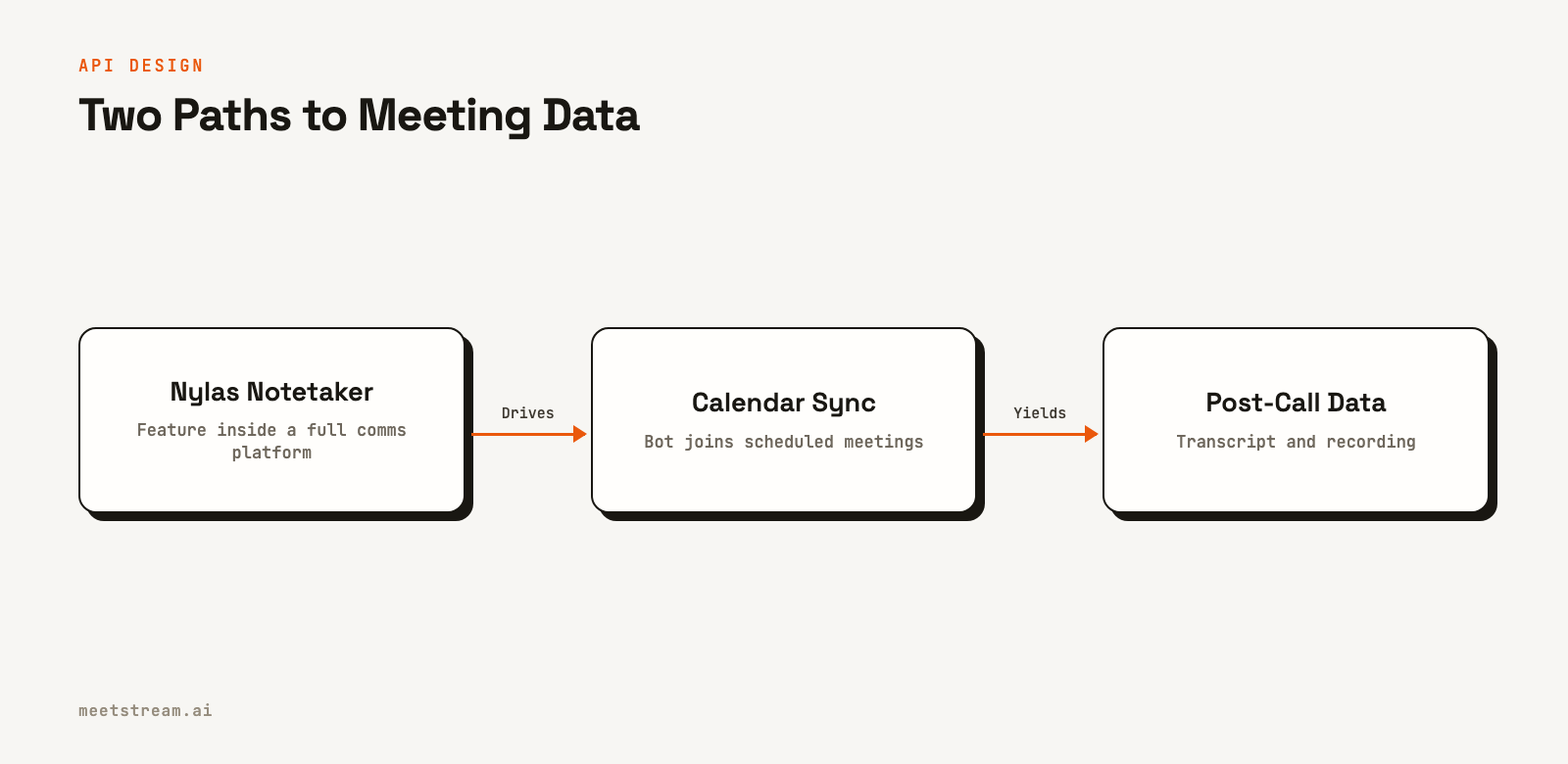
Recall.ai is a bot-infrastructure API. Its function is to place a bot into a meeting and return the media, such as recordings and transcripts. This focused approach allows it to support many meeting platforms. You are responsible for your own calendar logic, storage, and the final product that consumes the data.
Nylas Notetaker is a feature within a larger communications platform. Nylas provides unified APIs for email, calendar, and contacts, and the notetaker is an extension of that system. The main benefit is not granular media control, but the fact that the bot is already connected to your users' calendars. If your product is built on Nylas calendar sync, adding the notetaker is straightforward.
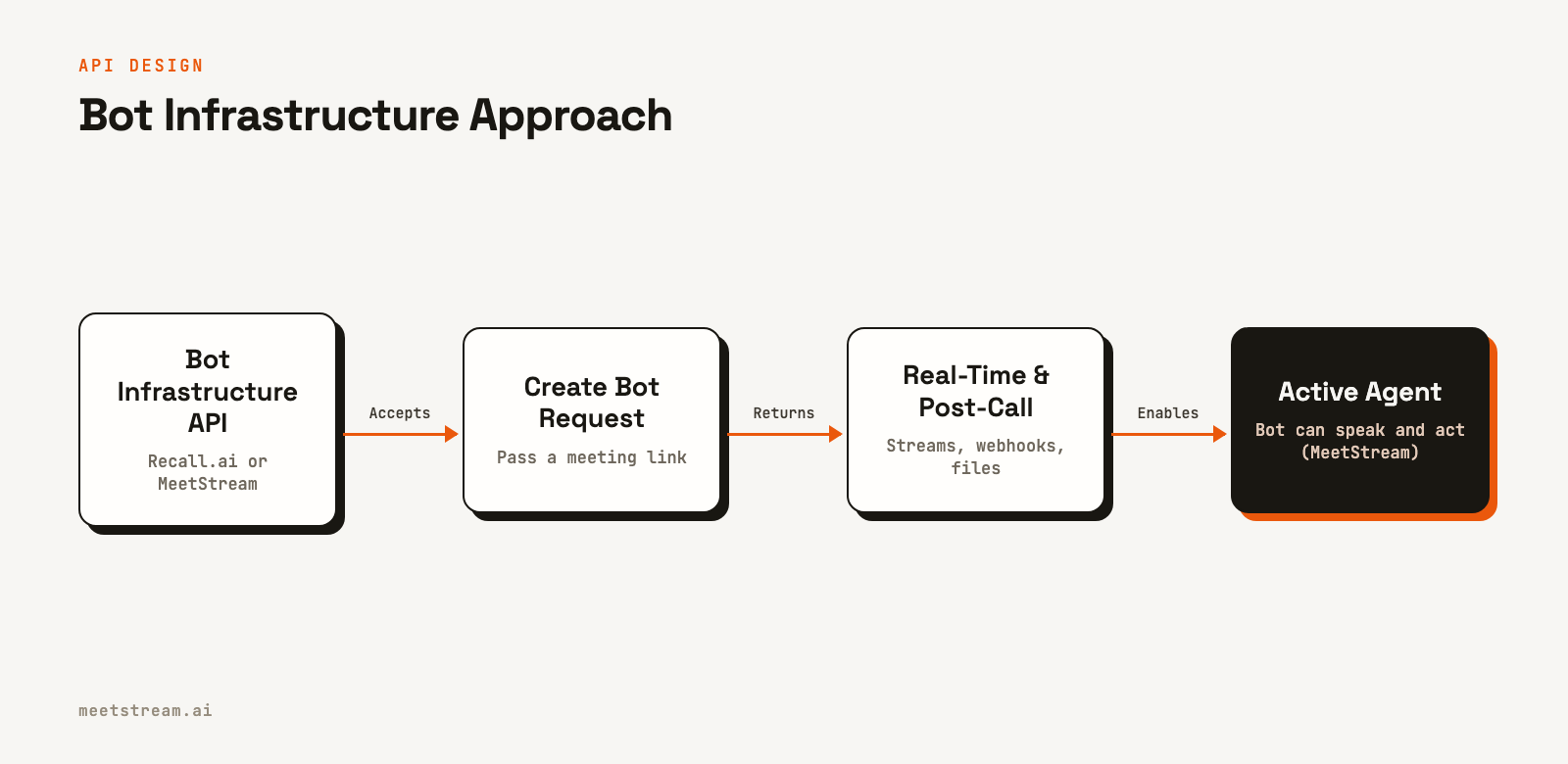
MeetStream is also bot infrastructure, but it is designed for developers who need more than passive recording. Our API provides real-time, per-participant audio over a WebSocket and allows bots to speak back into the meeting. This enables interactive AI voice agents, not just post-call summaries. The core design is for bots that are active participants in the meeting.
Platform Coverage and Reliability
All three services support Zoom, Google Meet, and Microsoft Teams. The key differences appear in their extended platform support and how they handle failure modes.
Recall.ai offers the broadest platform coverage, supporting Webex, GoTo Meeting, and Slack Huddles in addition to the main three. This is a significant factor if your users rely on these other platforms. Nylas Notetaker and MeetStream both focus on Zoom, Google Meet, and Microsoft Teams. MeetStream’s approach is to provide deeper features on these platforms, like per-participant streams and interactive agents, which are not universally available.
Reliability is critical because a failed recording cannot be retried. A meeting bot vendor must quickly adapt to UI changes from platform providers that can break join flows. How an API communicates failures like waiting rooms, denied entry, or an early meeting end is important. At MeetStream, we model these states with specific webhook events. Your application receives a payload with a bot_event field, with values like bot.joining, bot.inmeeting, bot.denied, or bot.failed. This allows your app to react to a problem immediately instead of discovering a missing recording later. This is a pattern we advocate for in our guide to webhooks vs polling for meeting data.
Real-Time Media vs. Post-Call Data
A post-call notetaker delivers a transcript after the meeting concludes. This is sufficient for generating summaries, extracting action items, or updating a CRM. It is not sufficient for live sales coaching, real-time intent detection, or a voice agent that responds to questions during the call. These use cases require access to the audio while the meeting is active.
Recall.ai provides access to real-time media, which makes it a common choice for developers needing more than just a recording. Nylas Notetaker is primarily focused on post-call outputs. MeetStream is built for live applications, sending real-time, speaker-attributed audio over a WebSocket connection. This supports in-call transcription, live analysis, or voice agents that can speak back into the meeting.
You can request a live transcription stream and a raw audio stream from the same bot. Here is a create_bot call with both real-time targets configured.
curl -X POST "https://api.meetstream.ai/api/v1/bots/create_bot" \
  -H "Authorization: Token <YOUR_API_KEY>" \
  -H "Content-Type: application/json" \
  -d '{
    "meeting_link": "<YOUR_MEETING_LINK>",
    "bot_name": "Realtime Notetaker",
    "live_transcription_required": {
      "webhook_url": "https://your-app.com/live-transcript"
    },
    "live_audio_required": {
      "websocket_url": "wss://your-app.com/audio"
    }
  }'
The streaming transcription payload includes speakerName, timestamp, transcript, and a words[] array with detailed timing. The raw audio arrives as binary frames over your WebSocket. Each frame contains a msg_type of 0x01, a speaker_id and speaker_name each preceded by a 2-byte length prefix, and then raw PCM audio data. This detailed, real-time data makes accurate meeting transcription possible during the call.
Active Agents: Bots That Do More Than Listen
Most meeting bot APIs are designed to get data out of a meeting. A different class of applications requires the bot to put information back in. A passive notetaker only listens. An active agent can speak, post messages in chat, or display an image as its video feed. This changes the bot from a recorder into a participant.
MeetStream exposes meeting control through a WebSocket command channel. By providing a socket_connection_url when creating a bot, you can send JSON commands to make the bot act. Commands like sendaudio, sendmsg, and sendimg allow the bot to speak, send chat messages, or show an image. This is the technical foundation for building a bot that can answer a question out loud or drop a relevant link in the chat. If your product requires this interactivity, it significantly narrows the choice of provider.
Side-by-Side Comparison
This table provides a direct comparison of the three services. We maintain a more detailed analysis in our Recall.ai alternatives guide. All pricing information is based on publicly available pages as of late 2026.
| MeetStream | Recall.ai | Nylas Notetaker | |
|---|---|---|---|
| Core Model | Bot infrastructure for interactive agents | Bot infrastructure for recording | Notetaker feature in a comms platform |
| Platforms | Zoom, Meet, Teams | Zoom, Meet, Teams, Webex, Slack, GoTo | Zoom, Meet, Teams |
| Real-Time Audio | Yes, PCM over WebSocket | Yes | Post-call focus |
| Live Transcription | Yes, streaming webhooks | Yes | Post-call focus |
| Per-Participant Audio | Yes. Fully isolated on Zoom; speaker-attributed on Meet and Teams. | Yes, with feature flag | No |
| Bot Can Speak/Act | Yes, via WebSocket control channel | No | No |
| Calendar Auto-Join | Yes, Google and Outlook | Yes | Yes, native to Nylas Calendar |
| Transcription Options | MeetStream in-house, Deepgram, AssemblyAI, JigsawStack, Sarvam | Recall.ai in-house, plus other providers | Bundled with platform |
| Security | ISO 27001, HIPAA, GDPR. SOC 2 Type 2 under audit. | SOC 2 Type II, ISO 27001, HIPAA, GDPR | Tied to Nylas platform |
| Published Price | $0.35/hr, volume tiers to $0.25/hr | $0.50/hr + $0.15/hr transcription | $0.70/hr (after first 300 mins) |
| Best For | Real-time apps, in-call agents, speaker-separated data | Broad platform coverage, completed SOC 2 report | Products already built on the Nylas API |
When to Choose Recall.ai or Nylas
Consider Recall.ai if you need to support meeting platforms beyond Zoom, Google Meet, and Microsoft Teams. Its broad coverage is a clear advantage. Recall.ai also holds a completed SOC 2 Type II report, which can be a deciding factor for compliance-driven procurement. MeetStream is ISO 27001 certified, GDPR and HIPAA compliant, and our SOC 2 Type 2 audit is in progress.
Choose Nylas Notetaker if your product is already standardized on the Nylas APIs for calendar and email. The convenience of adding a notetaker within your existing platform is a significant benefit. For any application that requires real-time data or in-meeting interaction, a dedicated bot infrastructure API like MeetStream or Recall.ai is a better architectural fit.
How MeetStream Fits In
MeetStream is a unified meeting bot API for deploying bots and AI agents into Zoom, Google Meet, and Microsoft Teams. You pass a meeting link to our API, and you get access to real-time audio, live and post-call transcription, and per-participant media streams. Our infrastructure has processed over 1,000,000 meeting minutes, giving us direct experience with what it takes to operate reliably at scale.
The same bot that records a meeting can also speak, post chat messages, and display images through a control channel. This allows you to build products that participate in the meeting, not just analyze it afterward. Our pricing is a flat $0.35 per hour, with volume tiers down to $0.25, making costs predictable as you grow. You can find the full API reference at docs.meetstream.ai.
Conclusion
In the Recall.ai vs Nylas Notetaker decision, the choice depends on your product's architecture. Recall.ai provides broad, unbundled bot infrastructure. Nylas Notetaker offers a convenient feature for products already built on the Nylas platform. MeetStream is the third option, designed specifically for developers building interactive agents that need to hear, speak, and act inside live meetings on Zoom, Google Meet, and Teams.
If your roadmap includes live coaching, real-time analysis, or voice agents, MeetStream provides the most direct path with its agent-first API and predictable pricing. For a broader view of the market, see our full comparison of Recall.ai competitors.
Frequently Asked Questions
What is the difference between Recall.ai and Nylas Notetaker?
Recall.ai is a standalone bot-infrastructure API focused on recording meetings across many platforms. Nylas Notetaker is a feature integrated into the Nylas communications platform, use its existing calendar and email APIs. The choice is between a specialized tool and a bundled feature.
Which is better for real-time applications?
For real-time applications, both Recall.ai and MeetStream are stronger choices than Nylas Notetaker. MeetStream is specifically designed for live use cases, providing low-latency audio over WebSockets and an API for making the bot speak and act during the meeting.
How much do Recall.ai and Nylas Notetaker cost?
Recall.ai has a pay-as-you-go rate of $0.50 per hour for recording, plus $0.15 per hour for transcription. Nylas Notetaker is priced at $0.70 per hour after an initial 300 minutes. MeetStream offers a flat rate of $0.35 per hour, which decreases with volume, making it a cost-effective option for applications at scale.
Can I get separate audio for each participant?
Yes. MeetStream provides per-participant audio streams. On Zoom, the streams are fully isolated. On Google Meet and Microsoft Teams, the streams are speaker-attributed, which still allows for highly accurate speaker diarization. Recall.ai also offers per-participant audio, but it is behind a feature flag.
Which API is best for building an AI agent that can talk in a meeting?
MeetStream is the best choice for building an AI agent that can participate in a meeting. Its API includes a WebSocket control channel for sending audio to the bot to speak, posting chat messages, and displaying images. This capability is central to our platform's design.


