
Recall.ai Alternatives: 5 Meeting Bot APIs Compared
Compare Recall.ai alternatives on real 2026 pricing, latency, per-participant streams, and in-meeting AI agents. MeetStream runs $0.35 per bot hour against Recall.ai's $0.50, with per-participant audio and video included.

When you start building a product that needs meeting data, Recall.ai is often the first name you encounter. They have strong SEO, solid documentation, and a Series B behind them. But they are not the only option, and for many use cases they are not the best fit. This guide compares the leading Recall.ai alternatives and competitors on real 2026 pricing, latency, and capability. The space has matured enough that there are now several credible options with meaningfully different tradeoffs.
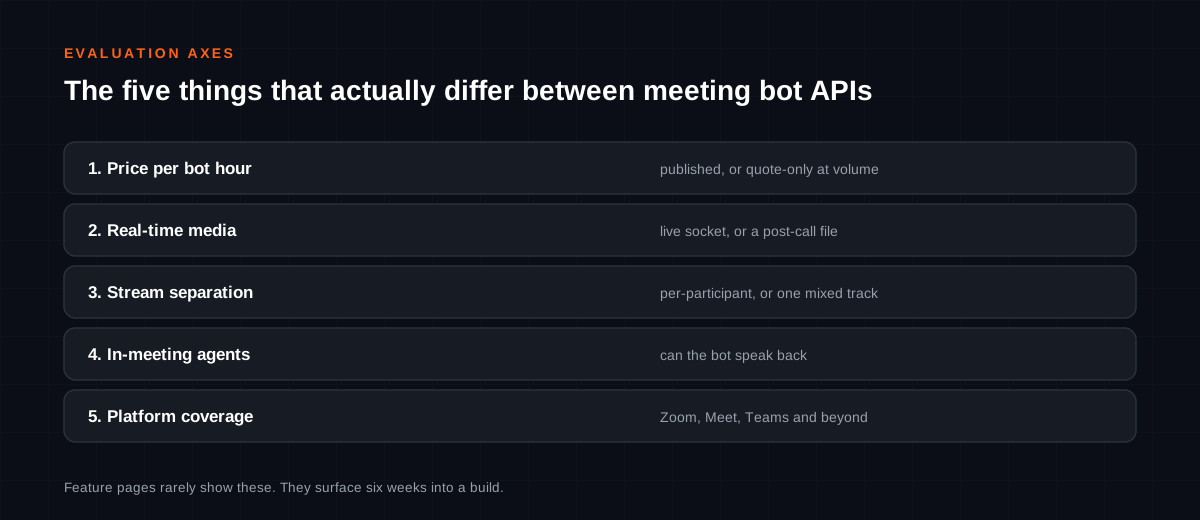
Evaluating meeting bot infrastructure is not like evaluating SaaS tools you can trial in an afternoon. The differences that matter, transcription flexibility, real-time audio architecture, platform nuance, webhook reliability under load, are not on a features page. They show up six weeks into a build, when the abstraction turns out not to fit.
This comparison covers five players: MeetStream, Recall.ai, Nylas Notetaker, MeetingBaaS, and Attendee.dev. It is a fair technical assessment, not a hit piece. You get what each platform does well, where each falls short, a capability table, an all-in pricing table, and how to choose.
The Short Answer
If you are building a product on meeting data and you want the best combination of price, latency, and agent capability, MeetStream is the strongest Recall.ai alternative. It is the only platform here with agent-first voice infrastructure so a bot can join, hear, and speak back inside the call. It supports per-participant media streams, fully isolated on Zoom, and speaker-attributed on Google Meet and Teams, and streams that media at roughly 200ms (self-reported). At $0.35 per bot hour against Recall.ai's $0.50, its all-in cost for a recorded and diarized hour is roughly $0.45 versus $0.80 on Recall.ai, and it drops to $0.25 per hour at volume.
Recall.ai is still the right answer if you need Webex or Slack Huddles coverage, if you need a client-side desktop recording SDK, or if a completed SOC 2 Type 2 and HIPAA posture is a procurement requirement today. Those are real advantages and worth paying for if they apply to you. For most teams building an AI meeting product, they do not.
What to Evaluate in a Meeting Bot API
Before the tables, be explicit about what actually matters when choosing meeting bot API infrastructure.
Platform coverage and transcription. Zoom, Google Meet, and Teams are the three that matter, and Zoom is the most constrained because of the App Marketplace requirement. Ask any vendor claiming Zoom support whether it uses the official SDK or browser automation. On transcription, picking your provider per call, rather than being locked to one engine, is what gives you control over quality, latency, and cost.
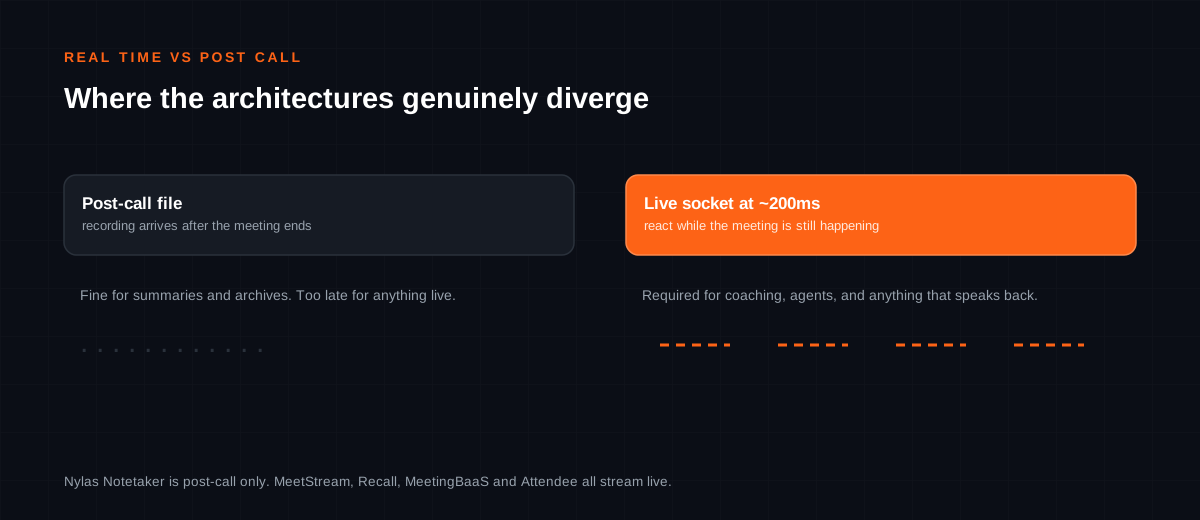
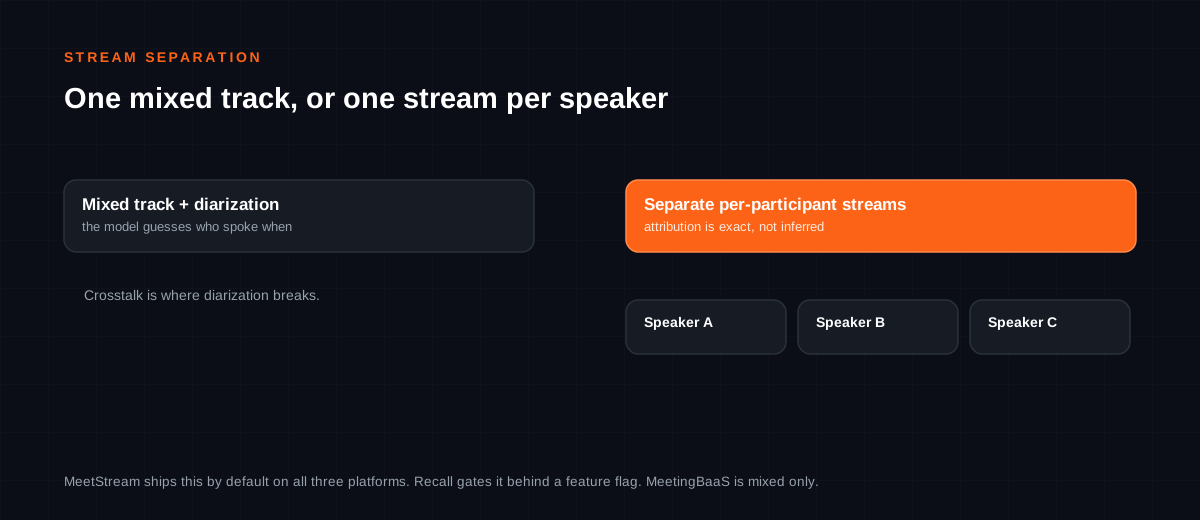
Real-time audio and stream separation. In-meeting agents, live coaching, and real-time compliance monitoring need audio during the call, not a file afterwards. The bigger question is whether you get one mixed track or a separate stream per participant, because that decides how much attribution work you do yourself.
Agents, self-hosting, and developer experience. An agent that responds in the meeting is a different product category from recording, self-hosting matters if residency rules say media cannot leave your environment, and docs plus webhook reliability decide how fast you ship.
Recall.ai Competitors in 2026
The direct Recall.ai competitors in meeting bot infrastructure are MeetStream, MeetingBaaS, Nylas Notetaker, and Attendee.dev. These are the products that, like Recall.ai, give you an API to put your own bot into a call. They are distinct from consumer notetakers such as Otter.ai, Fireflies.ai, and Fathom, and from conversation-intelligence suites like Gong and Chorus, which are finished per-seat applications rather than infrastructure you build products on.
On published rates as of August 2026, MeetStream is $0.35 per bot hour against Recall.ai at $0.50, which is 30 percent below Recall.ai's base rate. MeetingBaaS has moved to token-based hybrid pricing, so there is no comparable per-hour figure, and Nylas Notetaker publishes $5 per month including 300 minutes, then $0.70 per additional hour, per Nylas's published pricing page, fetched August 2026. The tables below break down what each of those rates actually buys. For a deeper look at each vendor, see our guide to Recall.ai competitors.
The Comparison
| Platform | Base price (Aug 2026) | Platforms Supported | Transcription Options | Per-Participant Streams | AI Agent Support | Open Source | Developer Experience |
|---|---|---|---|---|---|---|---|
| MeetStream | $0.35/hr (to $0.25 at volume), +$0.10/hr in-house diarized transcription, $5 free credit | Zoom, Meet, Teams | In-house diarized engine plus Deepgram, AssemblyAI, JigsawStack, Sarvam AI | Yes, with full isolation on Zoom and speaker-attributed streams on Google Meet and Teams, at roughly 200ms | Yes, voice, chat, and action modes with MCP connectivity | No | Clean REST API, one call to a bot, SDKs in 8 languages, CLI and MCP server, published pricing |
| Recall.ai | $0.50/hr pay-as-you-go, +$0.15/hr transcription, $0.05/hr storage after 7 free days, volume tiers quote-only | Zoom, Meet, Teams, Webex, Slack | Multiple providers configurable | Realtime separate audio caps at 16 speakers and excludes screenshare audio; async per-participant audio sits behind a feature flag; their docs recommend 4-core bots (+$0.10/hr) | Bot actions, no in-meeting voice agent | No | Strong docs, wide SDK coverage, desktop recording SDK, largest customer base |
| MeetingBaaS | Token-based hybrid pricing: plans from $0 to $299/mo plus tokens, no single per-hour rate | Zoom, Meet, Teams | Multiple providers | Mixed audio with diarization, not per-participant | Limited | No | Good docs, simpler API surface |
| Nylas Notetaker | $5/mo including 300 minutes, then $0.70/hr, sold inside the Nylas platform | Zoom, Meet, Teams | Nylas-managed (limited provider choice) | No (record then retrieve, no live media socket) | No | No | Integrated with Nylas Calendar API, good for scheduling-heavy apps |
| Attendee.dev | No licence fee, genuinely free to self-host; you pay your own infrastructure and operations | Zoom, Meet | Bring your own provider | Build it yourself | Extensible (open-source) | Yes (self-hostable) | Developer-first, requires more setup, active community |
Every figure above is the vendor's own published rate as of August 2026. Rates change, so confirm on their pricing pages before you commit.
What Each Rate Actually Includes
Base rates are not comparable on their own, because each vendor draws the line between "included" and "add-on" somewhere different. Here is one hour of the same workload, a bot that records, transcribes with speaker attribution, and keeps per-participant media, priced the way each vendor actually bills it.
| Vendor | Base recording | Transcription | Per-participant media | Storage | All-in for a transcribed, per-participant hour |
|---|---|---|---|---|---|
| MeetStream | $0.35/hr, $0.25 at volume | +$0.10/hr, in-house and diarized, or bring a configured provider | Available on all platforms at no extra cost | Managed, or write to your own S3 bucket | $0.45/hr, or $0.35/hr at volume |
| Recall.ai | $0.50/hr | +$0.15/hr | Their docs recommend 4-core bots for per-participant audio, +$0.10/hr | Free for 7 days, then $0.05/hr | Roughly $0.80/hr once you add all four lines |
| MeetingBaaS | Token-based hybrid pricing, plans from $0 to $299/mo plus tokens. No comparable per-hour figure. | Model it against your own token mix | |||
| Nylas Notetaker | $5 per month including 300 minutes, then $0.70 per additional hour, sold inside the wider Nylas platform. The published rate is not broken out by recording, transcription, or storage. | $0.70/hr beyond the included 300 minutes | |||
| Attendee.dev | No licence fee. Compute, storage, egress, and engineering time are yours. | Your infrastructure bill plus ops | |||
Two honest caveats. Recall's effective rate drops if you skip per-participant audio or long retention, and their volume tiers are quote-only, so a large contract may land well below $0.80. And no headline rate captures reliability, which is worth more than a few cents an hour when a missed recording is a customer-facing incident.
MeetStream: Built for Builders Who Need Real-Time
MeetStream optimises for the three things that decide whether a team ships: cost, latency, and how much infrastructure they have to own.
Lower all-in cost. $0.35 per bot hour, 30 percent below Recall.ai's $0.50 base, dropping to $0.25 at volume, with in-house diarized transcription as a $0.10 add-on. Every account starts with $5 in free credit, and the rate is published on a page rather than quoted on a call, so you can model cost before you talk to anyone. See the published pricing or the detailed Recall.ai pricing comparison.
Per-participant audio and video. Not a mixed track with diarization bolted on. You get fully isolated streams for each speaker on Zoom, and speaker-attributed streams on Google Meet and Teams. That gives you exact attribution, and the real-time WebSocket delivers PCM16 frames with per-speaker tags at roughly 200ms. That is the difference between an agent that reacts during the call and one that summarises afterwards. The pattern is in recording each participant separately.
Built-in voice infrastructure. The in-meeting agent framework supports voice, chat, and action response modes with MCP server connectivity, so the bot can listen, reason, and speak back inside the meeting. That is what a live meeting chat agent is built on, and no other managed platform here offers it.
Developer and startup friendly. One authenticated call with a meeting link puts a bot in the room, with no host-side plan and no admin install for your users. SDKs ship in eight languages, there is a CLI and an MCP server so coding agents can drive the API directly, and calendar integration auto-joins meetings on Google and Outlook up to three months ahead.
Platform coverage is Zoom, Google Meet, and Microsoft Teams. On trust, MeetStream is ISO 27001 certified, GDPR and HIPAA compliant, and is currently under audit for SOC 2 Type 2. See the full MeetStream vs Recall.ai comparison, the meeting bot API overview, or the security page.
Recall.ai: What It Does Well and Where It Falls Short
Recall.ai is the market leader in this space and has earned that position. Their platform supports the broadest range of meeting platforms including Webex and Slack Huddles, which most competitors do not. They ship a client-side desktop recording SDK for capturing calls outside the bot model entirely. Documentation is thorough, SDK coverage is wide, they hold SOC 2, HIPAA, and ISO 27001, and they have the largest customer base in the category. None of that is in dispute.
Where they are less flexible: per-participant media is not the default path. Per their own documentation, realtime separate audio caps at 16 speakers and excludes screenshare audio, async per-participant audio sits behind a feature flag, and the recommended configuration for it is a 4-core bot, which adds $0.10 per hour on top of the $0.50 base. In-meeting agent capability is limited to bot actions, with no voice response. Recall also markets "perfect speaker diarization" on their product pages, which is a strong claim for any inference-based approach; separate per-participant streams get you platform-level attribution without inferring anything. For most recording and transcription use cases, none of these gaps matter. For teams building real-time agents or products that process individual voices differently, they do.
Why Startups Pick MeetStream Over Recall.ai
Two things decide an early-stage build: what an hour of meeting data costs to run, and how quickly you can put something working in front of a user. MeetStream is built around both.
The all-in math. A recorded, diarized hour with per-participant media is $0.45 on MeetStream: $0.35 base plus the $0.10 in-house transcription add-on, with separate per-participant audio and video available at no extra cost. The same hour on Recall.ai lands near $0.80 once you add their $0.50 base, $0.15 transcription, roughly $0.10 for the 4-core bots their docs recommend for per-participant audio, and $0.05 per hour storage after the seven free days. At volume MeetStream's base drops to $0.25, so $0.35 all in. That is the lowest all-in cost of the options compared here, and the gap widens as usage grows.
No sales call to get a number. The rate is published on the pricing page, every account starts with $5 in free credit, there are no seat minimums and no annual commitment, and the volume tier sits on the same page as the base rate. You can model unit economics on a Saturday without booking a call. Recall.ai's volume tiers are quote-only, so a large contract may land well below $0.80, but you will not know until you talk to them.
The most agentic option here. This is the real differentiator. MeetStream ships built-in voice so the bot can reason and speak back inside the call, a Send Message API for posting into meeting chat, a Send Image API that handles animated GIFs, participant events and user journey data, and calendar auto-join on Google and Outlook up to three months ahead. On the tooling side there is an API reference, an MCP server and CLI on npm, a Claude skill, and SDKs in eight languages, so a coding agent can drive the whole API without a human in the loop. Recall.ai gives you bot actions. No other managed platform compared here lets the bot talk back in the room. See the integration list for what connects out of the box.
Nylas Notetaker: Calendar-First
Nylas Notetaker is not a standalone meeting bot API, it is a feature inside the Nylas platform, which is primarily a calendar and email API. If you already use Nylas for scheduling, adding bot deployment, recording, and basic transcription is low-friction, and it arrives with the calendar context you are already working in.
The tradeoff is that Nylas is not trying to be strong at meeting bot infrastructure. Transcription provider choice is limited, real-time streaming is not available, and the published rate is $5 per month including 300 minutes, then $0.70 per additional hour, twice MeetStream's $0.35 base. Calendar-centric product that needs basic recording: sensible. Anything needing flexibility or real-time: not the right fit.
MeetingBaaS: Pragmatic and Accessible
MeetingBaaS (Meeting Backend as a Service) is the practical, approachable option for developers who want something working quickly. The API surface is simpler than Recall.ai, documentation is clear, multiple transcription providers are supported, and real-time audio streaming is available.
Pricing has moved to a token-based hybrid model, with plans from $0 to $299 per month plus token consumption, so there is no clean per-hour number to compare. Model it against your own volume mix rather than a headline rate. The main gaps are in-meeting agent capability and per-participant granularity, since audio arrives mixed with diarization applied on top.
Attendee.dev: The Open-Source Option
Attendee.dev is the only fully open-source meeting bot platform in this comparison, and it is genuinely free: there is no licence fee, now or at scale. Self-hosting means you control the infrastructure, the data residency, and the extension points. For companies with strict compliance requirements or teams that want to build deeply custom behavior, that is a real advantage, not a consolation prize.
The honest cost is operational. Containerization, scaling a headless browser fleet, audio device management, platform policy monitoring, and the join flows that break whenever Zoom or Meet ships a UI change all become yours. The community is active and the codebase is well-structured, but that surface area recurs every month. Right choice for teams with infrastructure capability who need control over every layer; wrong choice for a two-person team shipping a feature. Our guide to open source Recall.ai alternatives covers the full self-host tradeoff.
How to Choose
If you are building real-time features, per-speaker processing, in-meeting AI agents, or a voice agent that talks back: MeetStream is purpose-built for exactly that, at $0.45 all in against roughly $0.80 on Recall.ai.
If you need Webex or Slack Huddles, a desktop recording SDK, or a completed SOC 2 Type 2 and HIPAA posture today: Recall.ai has the broadest platform coverage and the most mature compliance story.
If you are already in the Nylas ecosystem and want basic post-call recording: Nylas Notetaker requires the least integration work.
If you want simple recording and transcription and token pricing suits your volume: MeetingBaaS is worth evaluating.
If you need self-hosting for compliance and have the infrastructure capability: Attendee.dev is the only open-source option.
Get started free at meetstream.ai, browse the use cases, or read the full comparison set.
Frequently Asked Questions
What are the best Recall.ai alternatives in 2026?
The strongest Recall.ai alternatives are MeetStream, MeetingBaaS, Nylas Notetaker, and the open-source Attendee.dev. MeetStream is the pick for real-time per-participant streams and in-meeting voice agents at $0.35 per bot hour, MeetingBaaS for simple recording on token pricing, Nylas for calendar-first apps, and Attendee.dev when media must stay on your own servers.
What is the cheapest Recall.ai alternative?
Of the managed options compared here, MeetStream has the lowest all-in cost: $0.35 per bot hour against Recall.ai's $0.50, which is $0.45 for a recorded and diarized hour with per-participant audio and video available at no extra cost, and $0.25 per hour at volume. Attendee.dev has no licence fee, but you pay your own infrastructure and operations.
How much does Recall.ai cost per hour?
Recall.ai lists $0.50 per hour pay-as-you-go for recording, plus $0.15 per hour for transcription and $0.05 per hour for storage after seven free days. Per-participant audio effectively adds another $0.10 per hour because their docs recommend 4-core bots for it, so a fully loaded hour lands near $0.80.
Is there a free or open-source Recall.ai alternative?
Attendee.dev is genuinely free and open source, with no licence fee at any volume. You self-host it, which means you pay for compute, storage, and egress, and you own the browser fleet, the join flows that break on platform UI changes, and webhook reliability. The software is free; the operations are not.
Does Recall.ai support per-participant audio?
Yes, but not as the default path. Per Recall's own documentation, realtime separate audio caps at 16 speakers and excludes screenshare audio, async per-participant audio sits behind a feature flag, and the recommended setup is a 4-core bot at an extra $0.10 per hour. MeetStream makes separate audio and video per participant available at no extra cost, but it is not on by default.
Which Recall.ai alternative is best for startups?
MeetStream. Pricing is published with no sales call, every account starts with $5 in free credit, and there are no seat minimums. A recorded, diarized hour with per-participant media is $0.45 against roughly $0.80 on Recall.ai, and the base rate drops to $0.25 per hour at volume.
Which Recall.ai alternative is best for real-time streaming?
MeetStream. It delivers a real-time WebSocket with PCM16 frames and per-speaker attribution at roughly 200ms, self-reported, on Zoom, Google Meet, and Microsoft Teams. Attendee.dev can stream too, but you build the pipeline. Nylas Notetaker is post-call only, so live coaching and voice agents are not possible on it.
Can I switch from Recall.ai without rewriting my integration?
Mostly. Both are REST APIs built on the same shape: create a bot with a meeting link, receive webhooks through the meeting lifecycle, then fetch recordings and transcripts. Migration is usually re-pointing the base URL, swapping auth headers, and remapping webhook payload field names, rather than redesigning how your product consumes meeting data.
Which meeting bot API supports Zoom, Google Meet, and Microsoft Teams?
MeetStream, Recall.ai, MeetingBaaS, and Nylas Notetaker all cover the three major platforms. Recall.ai adds Webex and Slack Huddles. Attendee.dev focuses on Zoom and Google Meet, with thinner Microsoft Teams coverage. If Teams is a hard requirement, verify it on the vendor's own docs rather than a comparison page.
How do I compare meeting bot APIs for my use case?
Evaluate on six axes: platform coverage, transcription flexibility and cost, whether real-time media is per-participant or mixed, in-meeting agent capability, hosting model and data residency, and developer experience. Then price a realistic hour end to end, including transcription and storage add-ons, rather than comparing headline base rates.


