
Fault-Tolerant Meeting Bots: Retry Queues and Failover

A fault-tolerant meeting bot continues to function correctly even when parts of its underlying infrastructure fail. For developers building AI agents that interact in live meetings, this isn't a theoretical concern. An agent that drops from a sales call because a container crashed or a webhook was missed doesn't just fail a task, it erodes user trust at a critical moment. The goal is to design a system that anticipates and recovers from these failures automatically.
This is especially important for stateful applications like AI voice agents. These bots aren't just passive recorders; they are active participants that need to hear, speak, and act in real time. A brief network issue or a slow API response can desynchronize the agent, making its contributions irrelevant or disruptive. Building for fault tolerance means ensuring the agent can survive transient errors and infrastructure outages without losing context or failing the user.
In practice, this means moving beyond simple error handling. It requires an architecture that can withstand dropped network packets, API timeouts, and server restarts. Key patterns include using message queues to buffer and retry operations, designing API endpoints to handle repeated requests safely, and running redundant infrastructure that can take over when a primary system fails.
Let's walk through the patterns for building these resilient bots, from handling webhook failures with idempotency to designing for infrastructure outages with failover. It starts with understanding where things are most likely to break.
Why Meeting Bot Systems Fail
A meeting bot integrates multiple distributed systems: the meeting platform's API, your own application logic, and potentially several third-party services for transcription or language models. This creates several common points of failure. A primary one is webhook delivery. Your application might be temporarily unavailable due to a deployment or network partition when a critical event, like bot.stopped, is sent. Without a recovery plan, you could miss the signal to process a recording.
API calls are another frequent failure point. A request to an external service might time out under heavy load, or your application might hit a rate limit. If your bot relies on this API call to function, the entire operation could hang or fail. For bots that stream media, interruptions in the real-time audio stream can corrupt data, leading to inaccurate transcripts or faulty analysis.
Finally, the infrastructure itself can fail. A container orchestrator might restart a pod running your bot, or a server could go down entirely. If the bot's state isn't managed externally, a crash can mean losing all context for an in-progress meeting. Each of these scenarios requires a specific architectural pattern to handle it gracefully.
Handling Webhooks and Idempotent Design
Webhooks are the connective tissue of a meeting bot, signaling key lifecycle events. However, you must assume that webhook delivery over the public internet is not guaranteed. A provider might send an event once and consider its job done, a practice known as "best-effort" delivery. If your server returns a non-2xx response or is down at that moment, the event is lost.
The first step is to make your webhook handler fast and resilient. It should do the absolute minimum work required before returning a 200 OK status code, like placing the event payload onto an internal queue for later processing. This minimizes the window for network timeouts.
The second, more critical step is to make your event processing idempotent. An idempotent operation is one that can be performed multiple times with the same result as if it were performed only once. If you build your own retry logic, or if a provider sends a duplicate webhook, your system must not process the same event twice. A common pattern is to store a unique identifier for each event and check for its existence before processing.
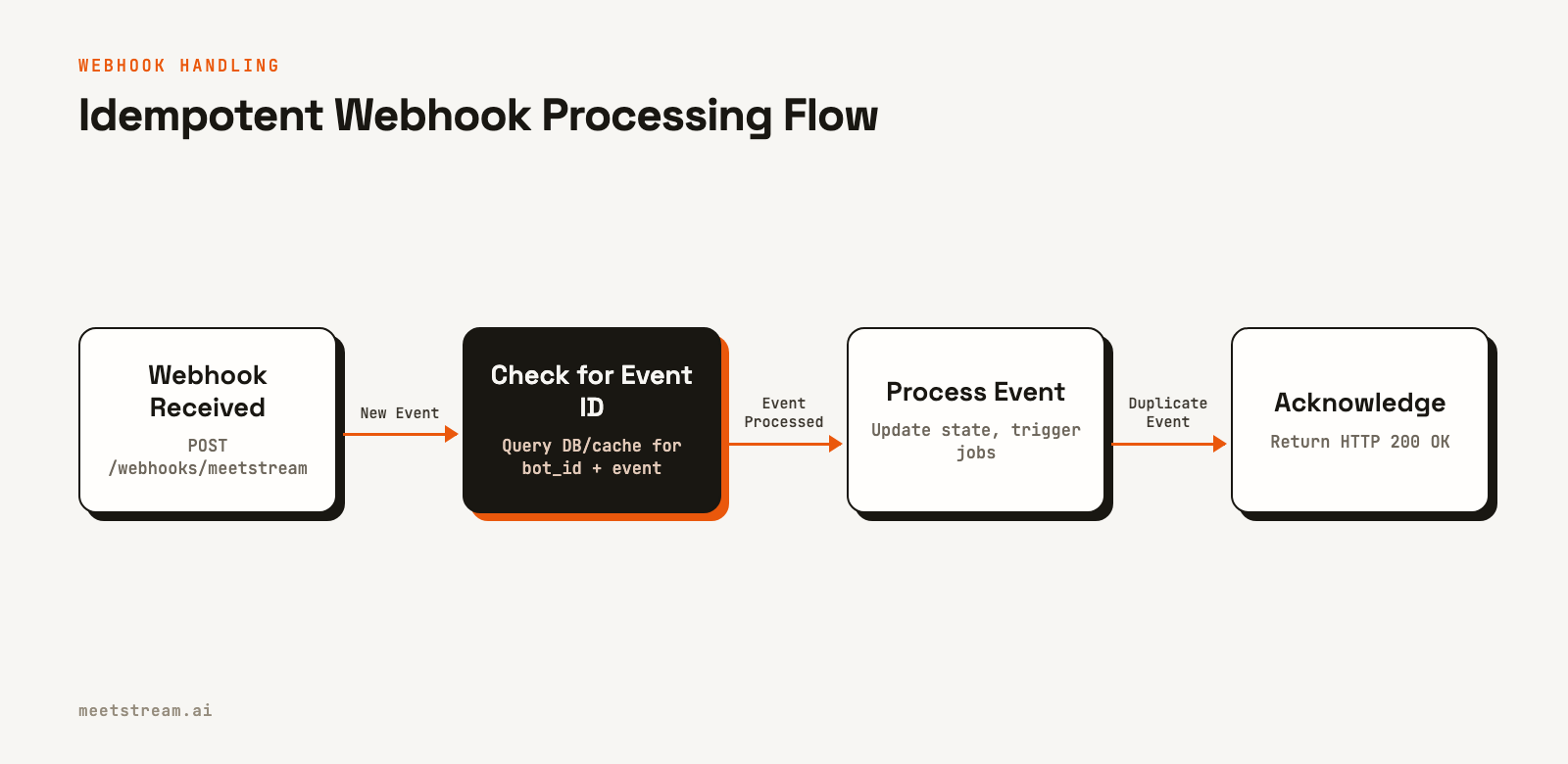
For MeetStream webhooks, an idempotency key built only from bot_id and bot_event is not unique, since the same event can repeat. A reliable key should be built from the bot_id, bot_event, and the payload's timestamp. When a webhook arrives, your handler first checks if this key already exists in a database or a Redis cache. If it does, you acknowledge the request with a 200 status but skip processing. If it doesn't, you process the event and then store the key before sending the acknowledgement.
# Python example using Flask and Redis for idempotency
from flask import Flask, request, jsonify
import redis

app = Flask(__name__)
# Use a real Redis client in production
redis_client = redis.StrictRedis(decode_responses=True)

@app.route('/webhooks/meetstream', methods=['POST'])
def handle_meetstream_webhook():
    payload = request.get_json()
    bot_id = payload.get('bot_id')
    event_type = payload.get('bot_event')
    timestamp = payload.get('timestamp')

    if not bot_id or not event_type or not timestamp:
        return "Invalid payload", 400

    # Create a unique key for this specific event
    idempotency_key = f"meetstream:{bot_id}:{event_type}:{timestamp}"

    # SETNX is an atomic "set if not exists" operation
    if redis_client.setnx(idempotency_key, "processed"):
        # Key was set, so this is a new event
        redis_client.expire(idempotency_key, 3600) # Expire key after 1 hour

        # TODO: Add the event to a background processing queue (e.g., Celery, RQ)
        print(f"New event received and queued for processing: {idempotency_key}")

        return jsonify(status="received"), 200
    else:
        # Key already exists, this is a duplicate event
        print(f"Duplicate event ignored: {idempotency_key}")
        return jsonify(status="duplicate"), 200

if __name__ == '__main__':
    app.run(port=5000)
Retry Queues with Exponential Backoff
For operations that can fail transiently, like calling an external API, a retry queue is essential. When an operation fails, instead of giving up, you place it in a queue to be attempted again later. This pattern decouples the initial request from the execution, making your system more resilient to temporary outages of downstream services.
A simple retry can overwhelm a struggling service. This is where exponential backoff comes in. Instead of retrying at a fixed interval, you increase the delay between each subsequent attempt. For example, you might wait 1 second after the first failure, 2 seconds after the second, then 4, 8, and so on, often with a small amount of random jitter to prevent a "thundering herd" of retries. This gives the downstream service time to recover.
After a certain number of failed attempts, it's time to stop. Continuing to retry an operation that is consistently failing can waste resources and hide a more serious problem. These permanently failing messages should be moved to a dead-letter queue (DLQ). A DLQ is a separate queue that holds messages that could not be processed successfully. Engineers can then inspect the DLQ to diagnose the root cause without blocking the main processing queue. Monitoring the size of your DLQ is a critical operational health signal.
Designing a Failover Architecture
While retry queues handle transient software failures, you also need a plan for hardware or infrastructure failure. If the server running your bot crashes, you need a way to either restart the bot or have another instance take over. This is the domain of failover architecture.
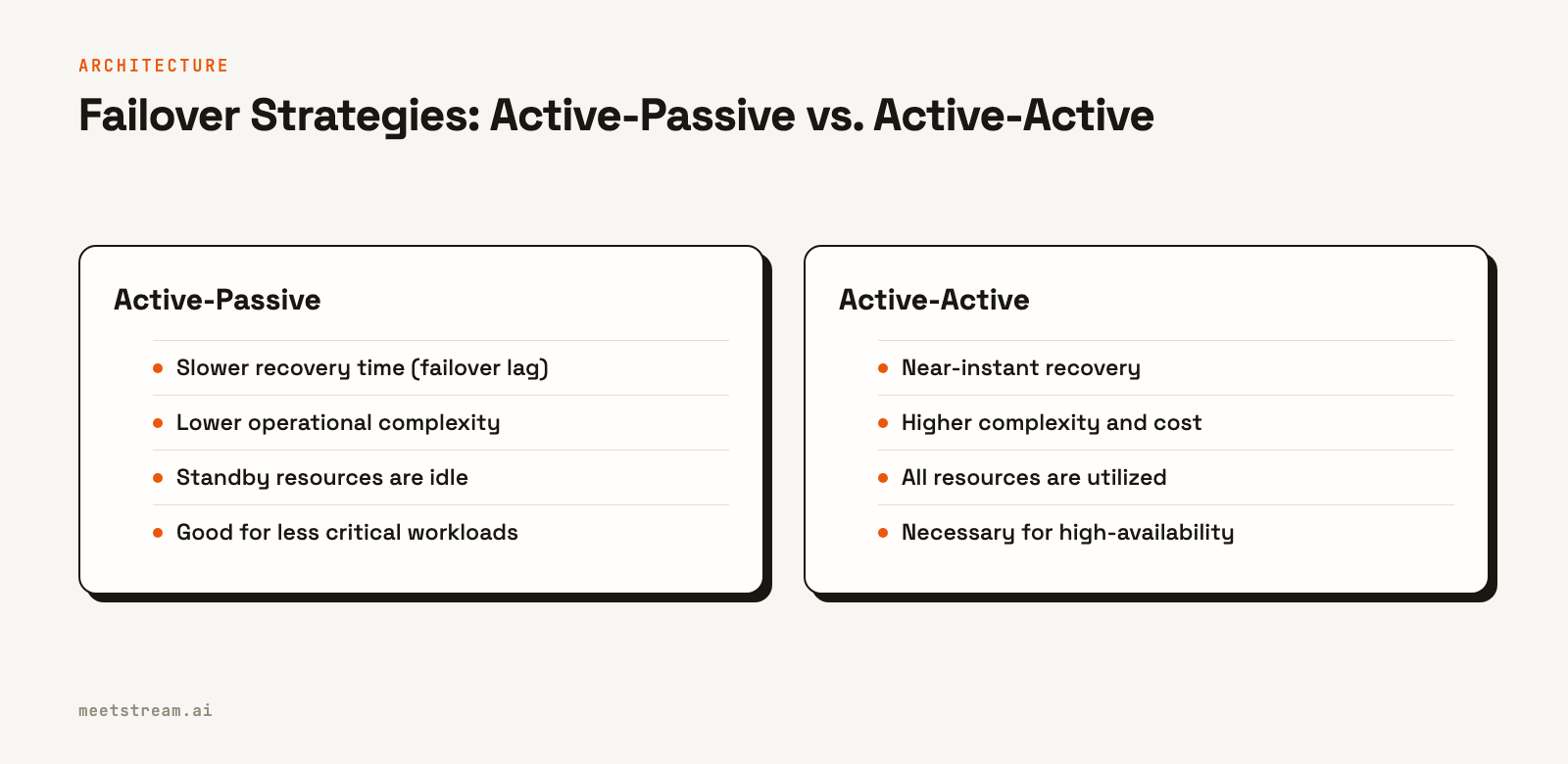
The two most common approaches are active-passive and active-active. In an active-passive setup, you have a primary instance handling all the work and a secondary, standby instance that is idle. A monitoring service watches the primary instance with health checks. If the primary fails, the monitor directs traffic to the standby instance, which becomes the new primary. This is simpler to implement but involves a delay during the failover process.
In an active-active architecture, you have multiple instances running simultaneously, and a load balancer distributes work among them. If one instance fails, the load balancer detects this via health checks and automatically redirects its traffic to the remaining healthy instances. This provides much faster, often cleanly, failover but is more complex to set up and manage, as you need to handle state synchronization between active instances.
Container orchestration platforms like Kubernetes simplify implementing these patterns. A Kubernetes Deployment can be configured to maintain a desired number of bot replicas (for an active-active setup) and will automatically restart any containers that crash, providing a basic level of self-healing.
Monitoring for Reliability
You cannot build a fault-tolerant system without good observability. You need to know when, why, and how often things are failing. This requires structured logging, metrics, and alerting.
Use structured logs that include context like a meeting_id or bot_id with every log message. This allows you to trace the entire lifecycle of a single bot's session across multiple services. When a failure occurs, you can quickly find all related logs to debug the issue.
Key metrics to monitor include the rate of API call failures, the number of messages in your retry queues and DLQs, and the restart count for your bot containers. Tools like Prometheus for metrics collection and Grafana for visualization can provide dashboards that give you a real-time view of your system's health. Set up alerts on these metrics to be notified of abnormal conditions, such as a sudden spike in the DLQ size, which could indicate a widespread outage.
How MeetStream Fits In
While you are responsible for the fault tolerance of your own application, MeetStream provides a reliable foundation to build upon. The platform is designed to manage the complexity of connecting to and capturing data from multiple meeting platforms like Zoom, Google Meet, and Microsoft Teams. We handle the scaling and management of the bot infrastructure, ensuring a bot is available to join a meeting when you make the API call.
The MeetStream API provides clear, discrete webhook events for a bot's lifecycle, such as bot.joining, bot.inmeeting, and bot.failed. This event-driven model is ideal for building resilient systems. You can use the custom_attributes field in the create bot request to pass your own unique identifiers, which are then echoed in every webhook payload. This simplifies tracking and implementing idempotency in your handlers.
For AI agents that require low-latency interaction, our infrastructure is optimized to deliver clean audio streams reliably over WebSockets. By offloading the core bot infrastructure management to MeetStream, your team can focus its engineering effort on building fault-tolerant application logic and delivering a great user experience.
Conclusion
Building fault-tolerant meeting bots is about accepting that failures will happen and designing a system that can handle them. It's not a single feature but an architectural approach. By using idempotent webhook handlers, implementing retry queues with exponential backoff, designing a failover strategy, and maintaining clear observability into your system, you can create bots that are resilient and trustworthy.
These patterns ensure that even when a network connection drops or a server crashes, your application can recover gracefully, preserving data integrity and maintaining a high-quality experience for your users. For developers building the next generation of AI meeting agents, this reliability is not just a technical detail, it's a core product requirement. See the full API reference at docs.meetstream.ai.
Related guides
Frequently Asked Questions
What is the best queue architecture for a reliable meeting bot?
A durable message queue like RabbitMQ or Amazon SQS is a good choice. Enable dead-letter queues (DLQs) to catch messages that fail repeatedly. Use exponential backoff for retries to avoid overwhelming a recovering service, and monitor the DLQ size as a key health metric.
How can I implement bot failover if a primary instance crashes?
Run at least two bot worker instances, ideally in different availability zones. Use a distributed lock, like one implemented with Redis, to ensure only one bot instance handles a given meeting. A watchdog service can monitor the primary and release the lock if it becomes unresponsive, allowing a standby instance to take over.
What is the difference between retry queues and circuit breakers?
Retry queues handle transient failures for individual tasks, like a single API call. Circuit breakers are a broader, system-level pattern. If a service shows a high failure rate, the circuit breaker "opens" and temporarily stops sending all requests to it, preventing cascading failures across the entire system.
How should I test failover behavior in a staging environment?
Use chaos engineering principles to inject failures. For example, you can randomly terminate a container running a bot mid-meeting and verify that a standby instance takes over within your defined recovery time objective. Your tests should assert that the final data, like a transcript, is complete and has no significant gaps.
How do I make my webhook processing idempotent?
Assign a unique identifier to every event. When your webhook handler receives an event, it should first check a persistent store (like a database or cache) to see if that identifier has already been processed. If it has, the handler should acknowledge the request but do no further work.


