
Recall.ai vs Skribby: Meeting Bot API Comparison
See how Recall.ai vs Skribby stack up for meeting bots, then where MeetStream fits with real-time streams and $0.35 per hour across Zoom, Meet, Teams.

The choice for a meeting bot API often comes down to two names. Recall.ai is an established platform with broad coverage. Skribby appears as a lighter option that looks cheaper for early-stage products. This comparison tests that assumption, because the core difference is not price but architecture. MeetStream is the only one of the three built as agent-first voice infrastructure, with real-time audio over WebSocket included so bots can join, hear, and act in meetings.
A meeting bot API is the component you do not want to rebuild. It joins Zoom, Google Meet, and Microsoft Teams on your behalf, captures the call, and provides a transcript and recording. Choosing the wrong layer means you either overpay for features you do not use, or you build on a platform that cannot support real-time agents when your product needs them.
This post compares how Recall.ai and Skribby differ, what each per-hour rate includes, and where MeetStream provides a third path. All figures are based on published pricing and technical documentation.
The short answer
Recall.ai is the broad, established meeting bot API. It has the widest platform support, desktop and mobile recording SDKs, and has completed SOC 2, HIPAA, and ISO 27001 certifications. Its pay-as-you-go rate is $0.50 per hour plus $0.15 for transcription and $0.05 for storage. Skribby is a lighter option at a $0.35 per hour base, but video recording is a $0.05 per hour add-on, transcription bundles run $0.39 to $1.36 per hour, and diarized options start at $0.45. MeetStream is $0.35 per hour with video and separate per-participant streams included, in-house diarized transcription at $0.10, and 30 days of storage. A fully recorded, diarized hour costs about $0.45 on MeetStream, $0.70 on Recall.ai, and $0.85 on Skribby. For a wider view, see our Recall.ai alternatives guide.
What Recall.ai and Skribby are each built for
Recall.ai and Skribby both get a bot into a call and return data, but they are built for different use cases, which is reflected in their design.
Recall.ai is built for teams that need the widest possible platform coverage and a mature integration path. Its support extends beyond the big three to Webex and Slack Huddles, and it offers desktop and mobile SDKs for botless capture. It also holds SOC 2, HIPAA, and ISO 27001 certifications. The tradeoff is a higher per-hour rate and an API designed for recording, not for real-time interaction.
Skribby is positioned as a budget-friendly notetaker bot. Its strengths include a $0.35 per hour base rate, support for over 24 bring-your-own-key (BYOK) transcription models, and a Tokyo data region. The tradeoffs are in what the base rate excludes. Video recording is an extra $0.05 per hour. Diarized transcription starts at $0.45. Recordings are kept for one week. There are no separate per-participant streams, no way for a bot to speak into the call, and no audited security certifications.
The framing is not "enterprise vs. budget." It is breadth and compliance on one side, and a low audio-only base rate on the other. MeetStream offers a third path: a single API for bots that join and act in meetings on Zoom, Google Meet, and Microsoft Teams. Video and per-participant audio are included in a base rate that drops from $0.35 to $0.25 per hour at volume. Our MeetStream vs Recall.ai breakdown covers these factors, and our guide to recording each participant separately explains why stream separation is important.
MeetStream vs. Recall.ai vs. Skribby: side by side
Here is a direct comparison of the two platforms and MeetStream as a third option. Per-hour costs are described relative to MeetStream's published $0.35 base rate.
| MeetStream | Recall.ai | Skribby | |
|---|---|---|---|
| Base rate, per bot hour | $0.35 (toward $0.25 at volume) | $0.50 pay-as-you-go | $0.35 |
| Video recording | Included | Included | +$0.05/hr add-on |
| Diarized transcription | +$0.10/hr, in-house engine | +$0.15/hr | from +$0.45/hr |
| Per-participant separate streams | Audio & video. Fully isolated on Zoom; speaker-attributed on Meet & Teams. | Audio available with feature flag | No, speaker timelines only |
| Bot Can Speak/Act | Yes, via API and WebSocket | No | No |
| Recording retention | 30 days | 7 days free, then $0.05/hr | 1 week |
| Published volume pricing | Yes, toward $0.25/hr | Quote only | Not published |
| Platforms | Zoom, Meet, Teams | Zoom, Meet, Teams, Webex, Slack, more | Zoom, Meet, Teams |
| Security certifications | ISO 27001 certified, GDPR, SOC 2 Type 2 under audit | SOC 2, HIPAA, ISO 27001 | None audited |
| Best for | Real-time apps, in-call agents, all-in price | Broad platform coverage, compliance | Audio-only notes with your own keys |
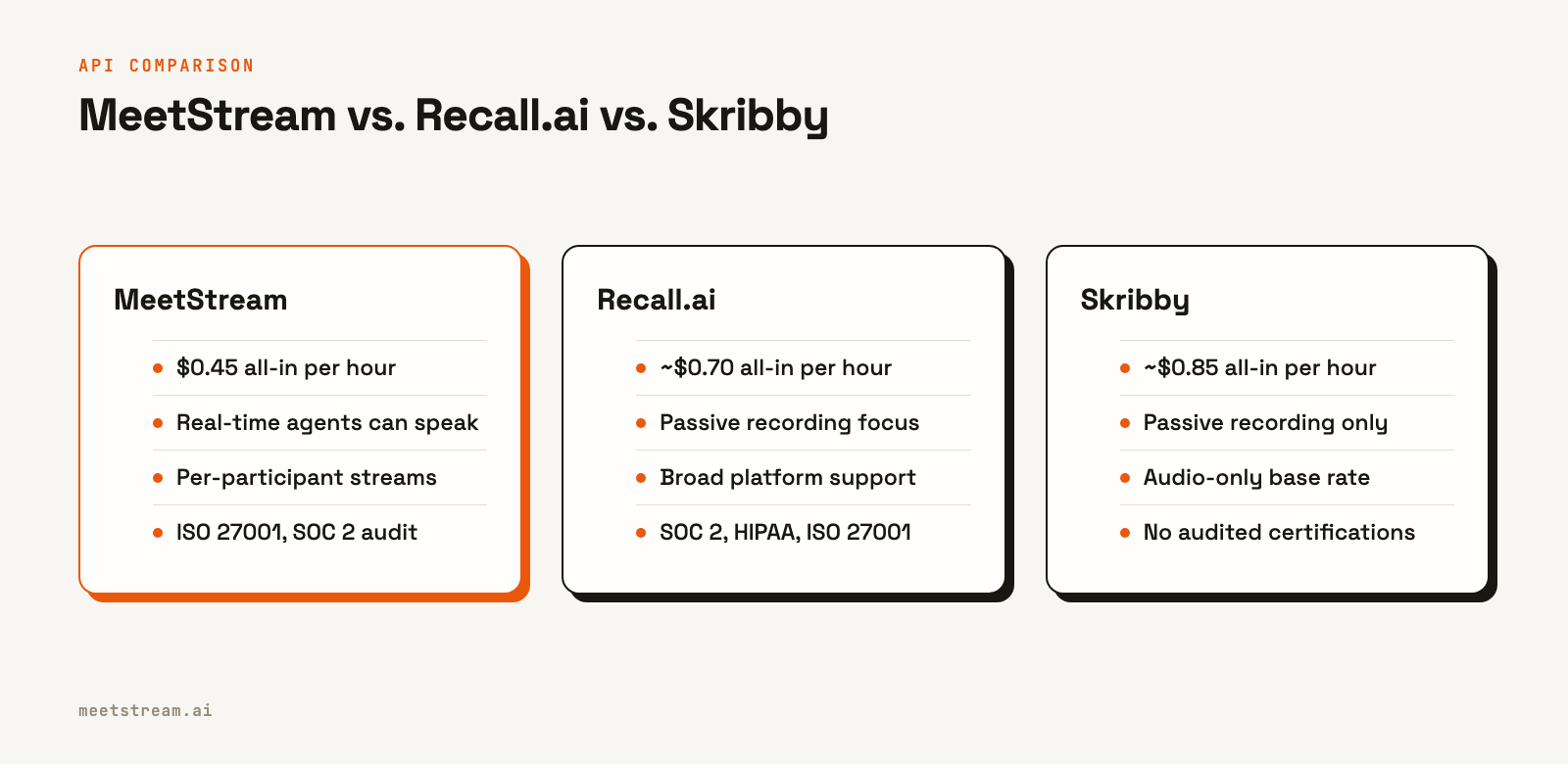
The pattern is clear. Recall.ai is a broad platform and the only one of the three with a completed compliance package. Skribby is a low-cost path for audio-only post-call notes, if you bring your own transcription keys and do not need video or stream separation. MeetStream is the choice for building agents that act inside the call, with real-time audio over WebSocket, per-participant streams, and a published price that falls as you scale. The full field is in our meeting bot API comparison roundup.
MeetStream vs. Recall vs. Skribby pricing: where the gap shows
Headline rates suggest Skribby is the cheap option and Recall is the expensive one. Pricing a real workload changes the order, because the three vendors define "base rate" and "add-on" differently.
Consider a typical workload: one hour, recorded with video, transcribed with speaker labels, and stored for a month.
| Line item | MeetStream | Recall.ai (pay-as-you-go) | Skribby |
|---|---|---|---|
| Bot hour, audio | $0.35 | $0.50 | $0.35 |
| Video recording | Included | Included | +$0.05 |
| Diarized transcription | +$0.10 | +$0.15 | from +$0.45 |
| Storage to 30 days | Included | +$0.05/hr past 7 days | Retention ends at 1 week |
| All-in, one recorded hour | $0.45 | $0.70 | from $0.85, without per-participant streams |
| At 10,000 hours a month | toward $0.25 base, published | Quote only | No published volume tier |
Three points emerge from that table.
Skribby's $0.35 is an audio-only rate. It matches MeetStream's base, but MeetStream's $0.35 includes video and separate per-participant audio and video streams. On Skribby, video is $0.05 more, and per-participant separation is not available. If your product needs to know who said what with certainty, that is a capability gap, not just a pricing difference.
Transcription is where the cost diverges. MeetStream's in-house diarized engine is a flat $0.10 per hour add-on. Skribby sells transcription as bundles, with diarized options starting at $0.45. The moment you need speaker labels, Skribby's transcription cost alone is more than MeetStream's entire recorded, diarized hour.
Retention and volume pricing matter. Skribby keeps recordings for one week. Recall gives you seven free days then meters storage at $0.05 per hour. MeetStream includes 30 days. As volume grows, MeetStream publishes its pricing tiers toward $0.25 per hour. Neither Recall nor Skribby publishes volume pricing.
Real-time and agents: the capability most comparisons skip
Most comparisons stop at recording and transcription. This is sufficient until your product needs to do something during the meeting.
A post-call transcript is enough for a summarizer. It is not enough for a live sales coach that flags objections, a real-time compliance monitor, or a voice agent that answers questions. Those require two things many bot APIs do not offer: a low-latency stream of attributed audio and transcript while the call is live, and a way to send audio, chat, or video back into the meeting.
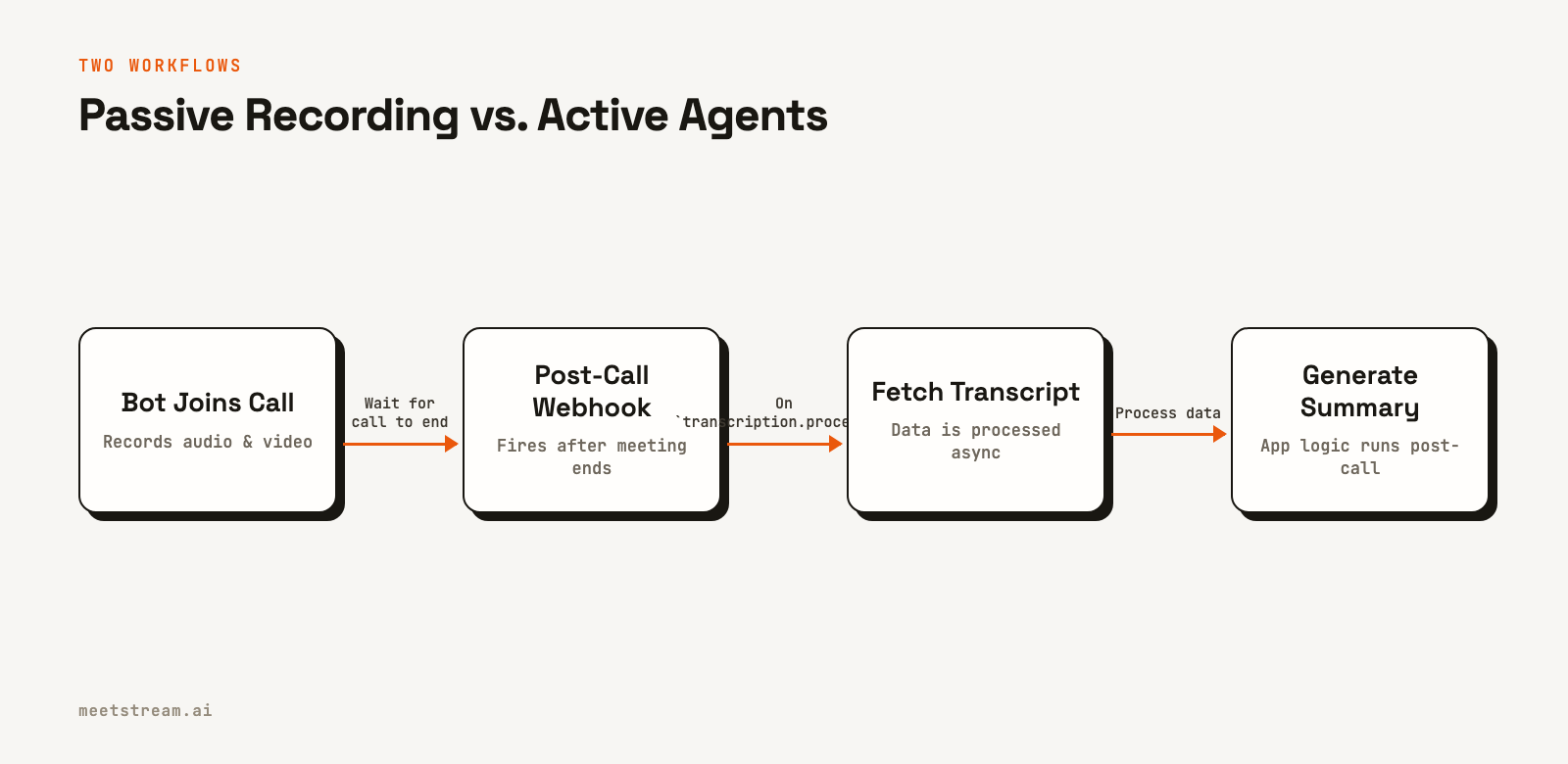
This is where MeetStream's design is different. You can get a live transcript via webhook as people speak. For active participation, you can stream real-time audio out over a WebSocket. To make the bot act, you use separate REST API calls to send a chat message or display an image as its video feed. A WebSocket connection is used for control commands and to send audio back into the call. This is the difference between a passive notetaker and an active AI voice agent.
Trying the MeetStream third option in code
If the comparison is relevant to your work, here is what an integration looks like. You send one request with a meeting link and a bot name, and a bot joins the call across any of the three platforms.
curl -X POST "https://api.meetstream.ai/api/v1/bots/create_bot" \
  -H "Authorization: Token <YOUR_API_KEY>" \
  -H "Content-Type: application/json" \
  -d '{
    "meeting_link": "<YOUR_MEETING_LINK>",
    "bot_name": "Notetaker",
    "recording_config": {
      "transcript": {
        "provider": {
          "deepgram": {}
        }
      }
    },
    "callback_url": "https://your-app.com/webhooks/meetstream"
  }'
The response is an HTTP 201 with a bot_id and a transcript_id. When the call ends, MeetStream sends a transcription.processed webhook to your callback_url, and you can fetch the speaker-labeled transcript. Lifecycle webhooks like bot.joining, bot.inmeeting, and bot.stopped provide the bot's status at every step.
To get the transcript live during the call, add a live transcription target and receive each chunk by webhook as people speak.
import requests

response = requests.post(
    "https://api.meetstream.ai/api/v1/bots/create_bot",
    headers={"Authorization": "Token <YOUR_API_KEY>"},
    json={
        "meeting_link": meeting_url,
        "bot_name": "Notetaker",
        "live_transcription_required": {
            "webhook_url": "https://your-app.com/live"
        },
    },
)

print(response.status_code)  # 201
print(response.json()["bot_id"])
Each live chunk includes speakerName, the transcript text, and a words[] array with per-word timing and confidence. This is the data feed required for attributing speaker labels correctly. Full payloads are in the API docs.
When to choose another meeting API
Recall.ai is an option if you need platforms beyond Zoom, Google Meet, and Microsoft Teams, because MeetStream does not cover Webex or Slack Huddles. Recall also offers a desktop or mobile recording SDK. For compliance, they hold a completed SOC 2 report, HIPAA, and ISO 27001, while MeetStream is ISO 27001 certified with SOC 2 Type 2 under audit.
Skribby is an option if your product records audio only, never needs video, and can work with one week of retention. It may also fit if you already hold contracts with other providers and want to bring your own keys, since it supports over 24 BYOK models. This is a different approach from MeetStream, which includes per-participant audio and video streams in its base rate.
Conclusion
The Recall.ai vs Skribby comparison is about what your per-hour rate includes. Recall.ai provides broad platform support and a completed compliance package for about $0.70 all-in. Skribby's $0.35 base rate is for audio only; a comparable hour with video and diarization costs $0.85 or more, without per-participant streams. MeetStream is built for voice agents that can join and speak in meetings. The $0.35 per hour base rate includes per-participant audio and video streams, with transcription at $0.10 extra. If your product roadmap includes live coaching or active agents, choosing a platform with real-time capabilities from the start avoids a future migration. Get started free at meetstream.ai.
Frequently Asked Questions
What is the difference between Recall.ai and Skribby?
Recall.ai is an established meeting bot API with broad platform support and multiple compliance certifications, at $0.50 per hour. Skribby is a lighter notetaker bot with a $0.35 per hour audio-only base rate, where video and diarization are paid add-ons. MeetStream is built for voice agents, with a $0.35 per hour base rate that includes per-participant audio and video streams.
How do Skribby and Recall.ai compare on cost?
Skribby's base rate of $0.35 per hour is lower than Recall.ai's $0.50. However, once you add video (+$0.05) and diarized transcription (from +$0.45), a comparable Skribby hour costs about $0.85. This is more than Recall.ai's all-in cost of around $0.70.
Is Skribby cheaper than MeetStream?
No. Their base rates are both $0.35 per hour, but MeetStream includes video recording and separate per-participant streams in that price. Skribby charges extra for video and does not offer stream separation. Diarized transcription is $0.10 on MeetStream and starts at $0.45 on Skribby.
How much does a recorded and transcribed meeting hour actually cost?
For one hour recorded with video and transcribed with speaker labels, the approximate cost is $0.45 on MeetStream, $0.70 on Recall.ai, and from $0.85 on Skribby. Skribby's cost does not include per-participant streams and has shorter data retention.
Which of these is SOC 2 or HIPAA compliant?
Recall.ai holds SOC 2, HIPAA, and ISO 27001 certifications. MeetStream is ISO 27001 certified and GDPR compliant, with SOC 2 Type 2 currently under audit. Skribby does not publish any audited certifications.


