
Recall.ai vs MeetingBaaS: Which Meeting Bot API?
Compare Recall.ai vs MeetingBaaS on platforms, real-time media, and price, plus a third meeting bot API to consider before you commit.

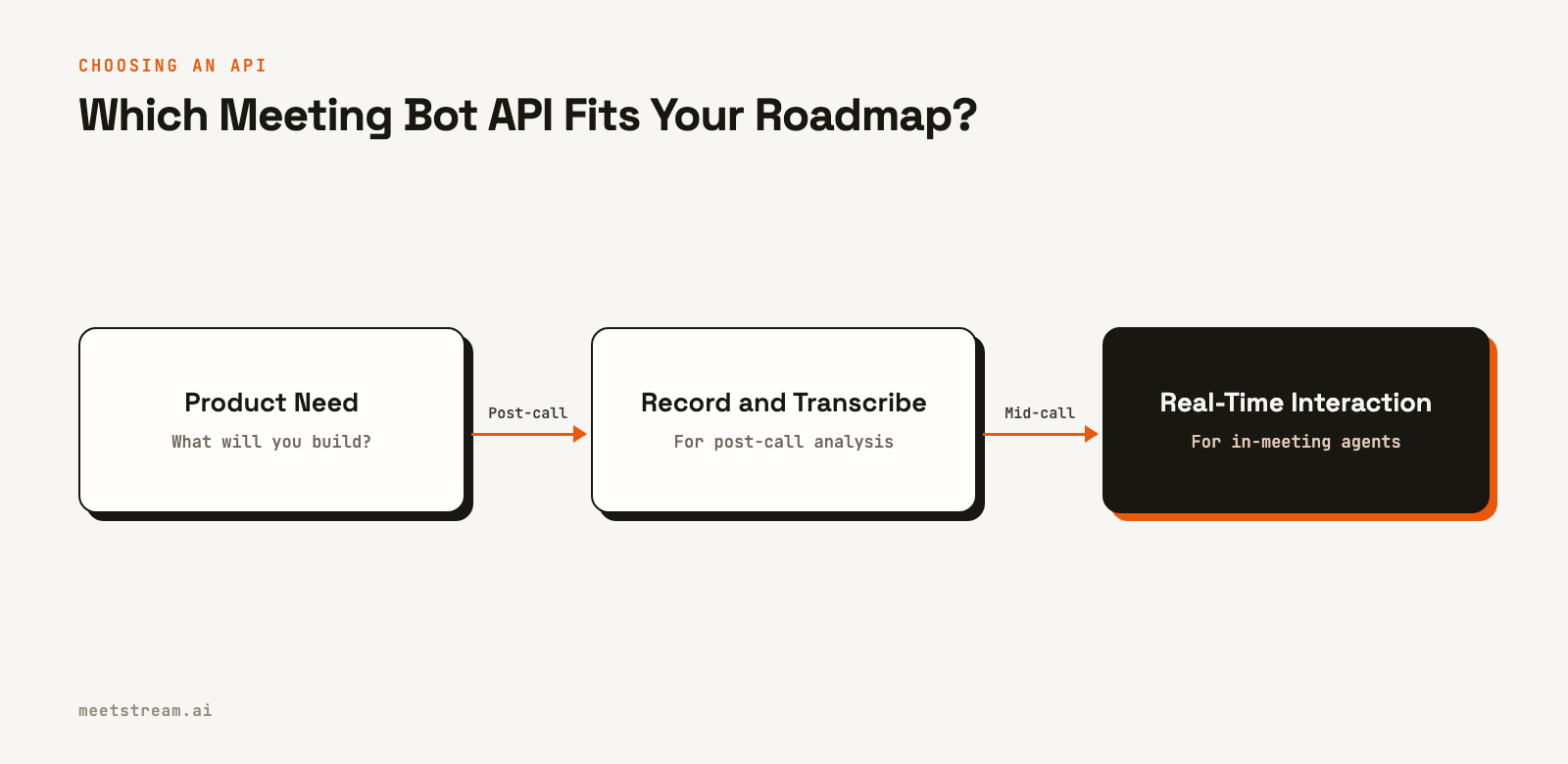
The choice between Recall.ai and MeetingBaaS comes down to your product roadmap. If you need a bot to record a meeting and deliver a transcript, both APIs can work. Recall.ai is an established platform with broad support, while MeetingBaaS is a leaner option focused on cost. The more important question is what you plan to build next. If your roadmap includes live coaching, in-meeting voice assistants, or any feature that requires acting on audio mid-call, you need an API built for real-time interaction.
This decision is difficult because a simple record-and-transcribe test doesn't reveal the underlying infrastructure. A bot that fails to join a call loses that data permanently, so reliability is more important than a long feature list. Real-time media access is another dividing line. An AI voice agent needs raw audio with low latency, not just a transcript after the call ends. Pricing models also differ, which can make direct comparisons misleading without considering your expected monthly volume.
Both Recall.ai and MeetingBaaS are established services. Recall.ai provides a managed meeting data platform, and MeetingBaaS offers a developer-focused API that competes on price. Yet for teams building interactive meeting tools, the essential features are real-time audio streams and the ability for an agent to speak. This is where MeetStream provides a clear alternative, as a platform designed specifically for voice agents that can participate in meetings.
What Recall.ai and MeetingBaaS Do
Both Recall.ai and MeetingBaaS solve the same core problem: they get a bot into a Zoom, Google Meet, or Microsoft Teams call so you do not have to build and manage that infrastructure. You provide a meeting link to their API, a bot joins, and you receive a recording and a transcript. This abstraction is valuable. The alternative is running a headless browser for each concurrent meeting, capturing system audio, and constantly updating join flows as platforms change their user interface.
The platforms differ in their approach. Recall.ai is a managed data platform with wide platform support and calendar integrations. MeetingBaaS is a lightweight, developer-first option with a simpler API surface. MeetStream is built for a different purpose entirely. It is an agent-first platform with the voice infrastructure for bots to not just listen, but to join as participants and speak, enabling interactive use cases not possible with recording-focused APIs.
The common mistake is treating these services as interchangeable because the initial API call looks similar. The differences that matter appear under load: join success rates on poor networks, the ability to get raw audio mid-call, how webhooks behave when your endpoint is down, and what the bill looks like at production scale.
Platform Coverage and Integrations
Recall.ai supports the widest range of meeting platforms, including Zoom, Google Meet, Microsoft Teams, Webex, and Slack Huddles. MeetStream focuses on providing deep, real-time functionality for the three platforms where most business meetings occur: Zoom, Google Meet, and Microsoft Teams. This focus allows MeetStream to offer a consistent API for features like per-participant audio streams and voice agents that can speak in the call.
MeetingBaaS also covers Zoom, Google Meet, and Microsoft Teams, keeping its integration surface small by design. For a product whose customers primarily use these three platforms, a narrower scope can be a feature, reducing complexity. Our platform-specific guides cover the details for building a Zoom meeting bot, a Microsoft Teams bot, and a Google Meet bot.
Platform coverage is easy to overvalue. Most teams building meeting intelligence products serve users on Zoom, Meet, and Teams, and all three vendors cover them. If you do not have a clear need for the long tail of platforms, you may not want to pay for it in complexity or price. MeetStream supports the main three platforms with a single integration and offers calendar auto-join through Google and Microsoft Calendar.
Real-Time Media: The Critical Difference
This is where the comparison becomes sharp. Many teams make the wrong choice because they only test the post-call transcription path.
If all you need is a recording and a transcript after the meeting ends, both Recall.ai and MeetingBaaS are viable options. The split happens when you need to act on audio or video mid-call, which is a requirement for a live sales coach, a real-time compliance monitor, or a voice agent. MeetStream is built for these real-time use cases, providing raw, speaker-attributed audio over a WebSocket connection. This lets you build agents that can hear and speak in the meeting. Recall.ai also offers real-time media, while MeetingBaaS has historically focused on the record-and-transcribe model.
Choosing an API without live audio capabilities can lead to a difficult migration later. If you ship a post-call notetaker and your roadmap later calls for a live assistant, you will need to switch providers. It is better to choose an API based on the product you intend to build, not just the one you are demoing today. We explain how to handle speaker labels and why low-latency is critical for real-time transcription in other posts.
MeetStream was designed for this specific need. It exposes raw audio and video as live streams, including separate per-participant audio, and provides a bidirectional WebSocket so a bot can speak, send chat messages, and share images back into the call. This capability changes a passive recorder into an active meeting agent.
Reliability and Webhooks
Reliability is a feature that is not marketed but is felt in production. The best way to evaluate it is to ask vendors direct questions. What is your join success rate? How do you handle waiting rooms and denied entries? What happens when a host ends a call unexpectedly? Do you retry webhooks if my endpoint returns a non-2xx response?
Recall.ai has a longer operational history and has likely encountered many join scenarios. MeetStream has processed over a million meeting minutes and is built for reliability at scale, especially for real-time applications sensitive to latency and connection stability. We have run approximately 80,000 bots and encourage developers to run their own concurrency and edge-case tests on any platform before committing to a launch.
On webhooks, read the delivery guarantees carefully. MeetStream, for example, treats webhooks as best-effort and does not retry on a non-2xx response. This means your endpoint must be highly available and acknowledge receipt quickly. This is a standard design, but it is a detail that can determine whether you lose data, and it often does not appear in feature comparisons.
Comparing Recall.ai vs MeetingBaaS on Price
Price is often the initial reason teams compare Recall.ai and MeetingBaaS. MeetingBaaS competes with a lower per-hour cost than Recall.ai. Recall.ai is priced higher, justified by its broader platform support and maturity. We are not quoting exact competitor numbers here because they change. We recommend you confirm them directly rather than relying on a blog post.
The principle is to compare prices at your expected production volume, not at the free tier. A rate that seems acceptable at 100 hours a month can become a significant part of your cost of goods at 10,000 hours.
MeetStream is priced at $0.35 per hour, with rates moving toward $0.25 per hour at volume. Transcription is available as an add-on, and MIA, the in-meeting voice agent, is priced separately. This pricing puts it below the established incumbent on a per-hour basis while providing real-time streams and in-call agent capabilities. The most expensive meeting bot API is the one you have to replace after you have shipped your product on it.
Side-by-Side Comparison
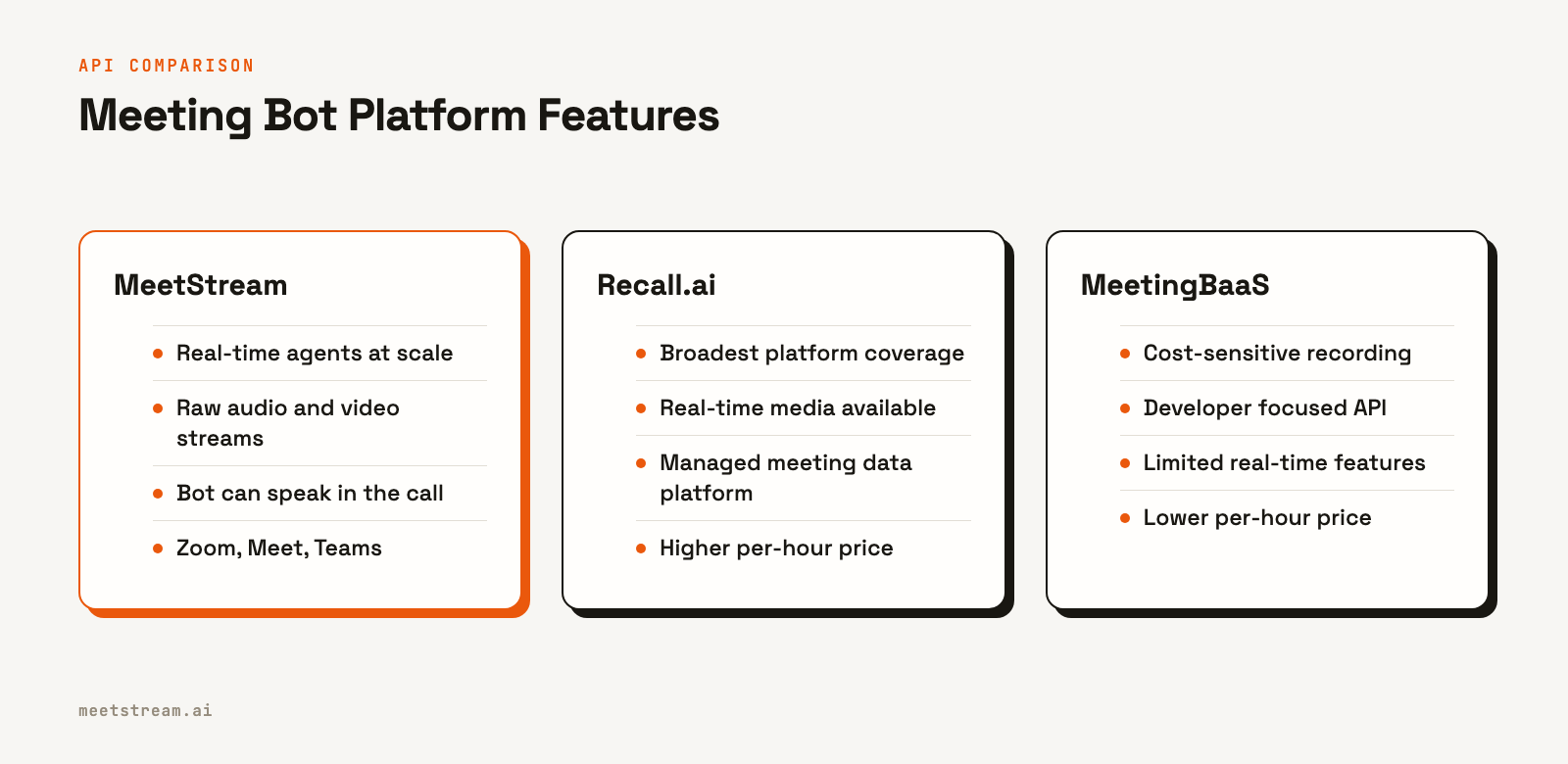
Here is a direct comparison of the three platforms. We maintain a longer list in our guide to Recall.ai alternatives.
| MeetStream | Recall.ai | MeetingBaaS | |
|---|---|---|---|
| Core Platforms | Zoom, Meet, Teams | Zoom, Meet, Teams, more | Zoom, Meet, Teams |
| Hosting | Managed | Managed | Managed |
| Real-Time Audio/Video | Yes, raw streams | Yes | Limited, confirm |
| Per-Participant Streams | Yes (full on Zoom; partial on Meet/Teams) | Partial | Confirm |
| Bot Speaks in Call | Yes, via MIA | No | No |
| Calendar Auto-Join | Yes (Google/MS) | Yes | Yes |
| Per-Hour Price | $0.35 (toward $0.25) | Higher per-hour | Lower per-hour |
| Best For | Real-time agents at scale | Broadest coverage | Cost-sensitive recording |
How MeetStream Fits In
MeetStream is a unified API for deploying bots and AI agents into Zoom, Google Meet, and Microsoft Teams. One integration covers all three platforms. You pass a meeting link, and a bot joins, records, and sends speaker-labeled transcripts through webhooks for the full bot lifecycle. The same bot can expose raw per-participant audio as a live stream and speak, post chat messages, or share images back into the call through a WebSocket bridge.
Here is the API call to create a bot. It is the same for all three platforms:
curl -X POST "https://api.meetstream.ai/api/v1/bots/create_bot" \
  -H "Authorization: Token <YOUR_API_KEY>" \
  -H "Content-Type: application/json" \
  -d '{
    "meeting_link": "<YOUR_MEETING_LINK>",
    "bot_name": "Recorder Bot",
    "video_required": false,
    "recording_config": {
      "transcript": {
        "provider": { "deepgram": { "language": "en", "model": "nova-2" } }
      }
    },
    "callback_url": "https://your-app.com/webhooks/meetstream"
  }'
The call returns an HTTP 201 response with a bot_id, a transcript_id, the meeting_url, and a status of "Active". Lifecycle webhooks fire on events like bot.joining, bot.inmeeting, and bot.stopped. Post-call events fire for audio.processed and transcription.processed. This provides the infrastructure layer so you can focus on your product, not the bot fleet. You can see the full payloads and SDKs for Python, JavaScript, Go, and more in the API documentation.
Conclusion
In the Recall.ai vs MeetingBaaS comparison, Recall.ai offers the broadest platform coverage, while MeetingBaaS competes on a lower price for basic recording. This framing, however, misses the critical third option for modern AI applications. MeetStream is an API built for agents that act inside the call, with real-time audio over WebSocket and per-participant media streams. At a price of $0.35 per hour that drops to $0.25 at volume, it provides the voice infrastructure for bots that do more than just listen. If that is where your product is headed, see the full API reference at docs.meetstream.ai.
Frequently Asked Questions
What is the main difference between Recall.ai and MeetingBaaS?
Recall.ai focuses on broad platform coverage at a higher price point, making it a complete data platform. MeetingBaaS prioritizes simplicity and a lower cost for core recording and transcription on major platforms. The choice depends on whether you need wide support or a cost-effective solution for basic tasks.
Is there a better Recall.ai alternative for real-time audio?
Yes, MeetStream is a strong Recall.ai alternative for real-time use cases. It provides raw per-participant audio and video as live streams over WebSockets and allows bots to speak in the call. This is designed for building interactive AI agents, not just post-call analysis.
Can these meeting bot APIs provide a live transcript?
Some can. Both Recall.ai and MeetStream offer real-time media streams that can be used to generate live transcripts. MeetStream is specifically designed for this, streaming speaker-labeled audio and providing a control channel for the bot to respond, which is necessary for live coaching and voice agents.
How should I compare meeting bot API pricing?
Compare costs at your expected production volume. A low per-hour rate at 100 hours might not be the cheapest option at 10,000 hours. While MeetingBaaS is often cheaper per hour than Recall.ai, MeetStream's pricing is structured to support agent-first applications at scale, starting at $0.35 per hour.
Which API is best for building AI meeting agents?
MeetStream is the best choice for building AI meeting agents. Unlike passive recording APIs, it provides the necessary infrastructure for real-time interaction: low-latency audio streams, per-participant media, and the ability for a bot to speak and send messages during the meeting across Zoom, Meet, and Teams.


