
Open Source Recall.ai Alternatives: Attendee and Vexa Compared
Compare MeetStream with Recall.ai and other meeting bot APIs in 2026, and when a managed API at $0.35/hr wins instead.

Open source Recall.ai alternatives like Attendee and Vexa give you full control over meeting data and remove per-hour billing. The tradeoff is that you must run the underlying infrastructure, which shifts the cost from a vendor bill to your own engineering and operational budget.
This is the build-versus-buy decision for meeting bots. You are trading a predictable API fee for the responsibility of running a browser fleet, maintaining join logic, and managing a media processing pipeline. At MeetStream, we provide the agent-first voice infrastructure for meetings. Our API offers the capabilities of a self-hosted solution, like real-time audio streaming, without requiring you to operate that infrastructure. We have run over 80,000 bots across more than a million meeting minutes, handling the scaling and reliability so you can focus on your application.
This article examines the open source options, what they do well, and where the operational work is. We compare the total cost of ownership for self-hosting against a managed API, so you can make the right choice for your scale and compliance needs.
Why Teams Consider Open Source Alternatives
Developers look for an open source path for a few specific reasons. The first is cost at scale. Per-hour billing from a managed provider can become a major line item at 10,000 hours a month. For products where recording is a core feature, self-hosting appears to be a direct path to better margins.
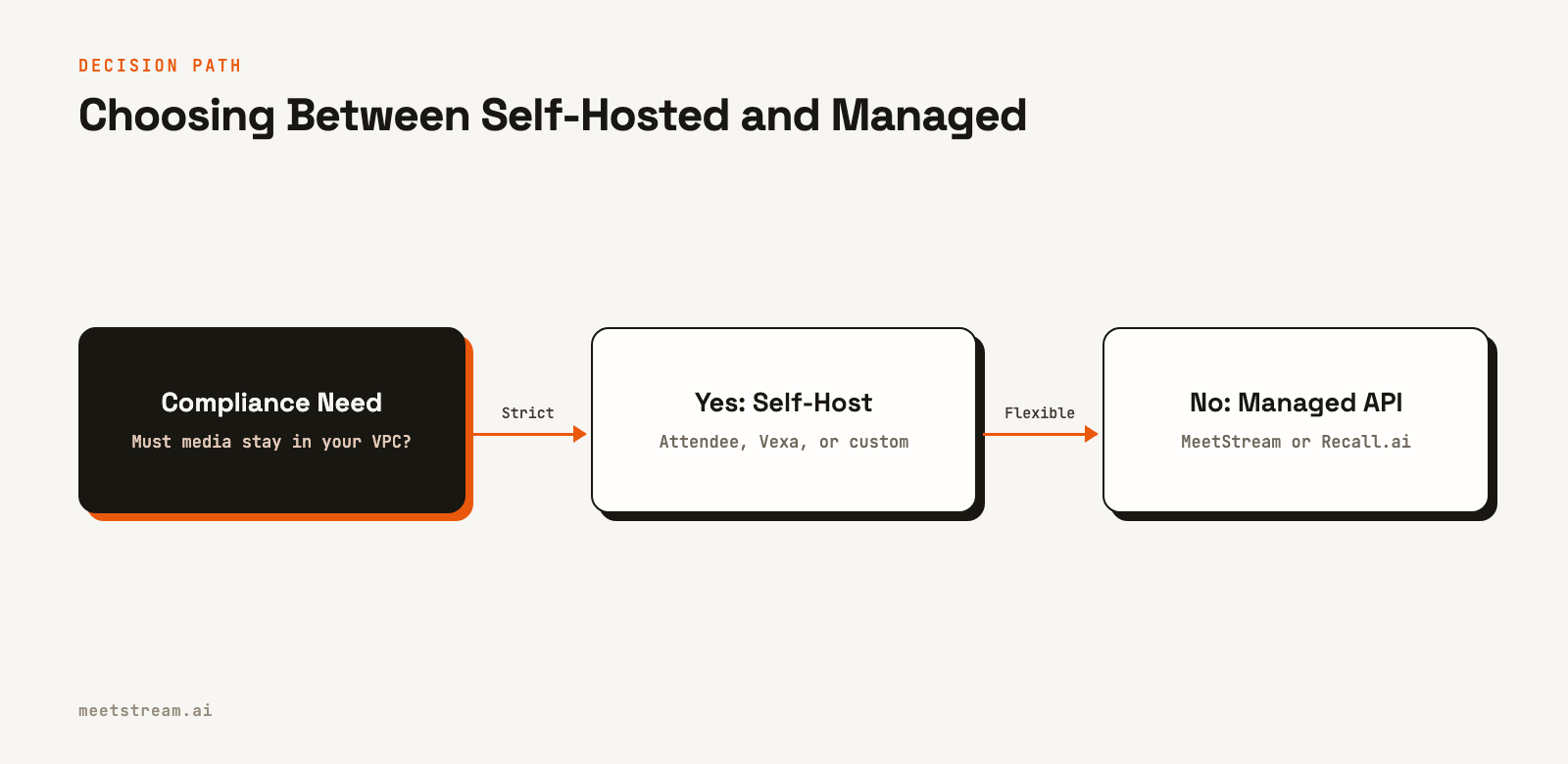
The second is data residency. Teams building for healthcare, legal tech, and finance often have strict compliance rules that prevent sending meeting media to a third party. For these teams, the primary question is not price, but whether sensitive audio and video data ever leaves their controlled environment. Self-hosting an open source bot keeps all media within a VPC they manage.
The third is control. Some engineering teams prefer to read the join logic, patch it themselves, and avoid dependencies on a vendor's roadmap. Open source provides this transparency. Our main Recall.ai alternatives guide covers the managed options for teams facing this same decision.
The Real Cost of Self-Hosting a Meeting Bot
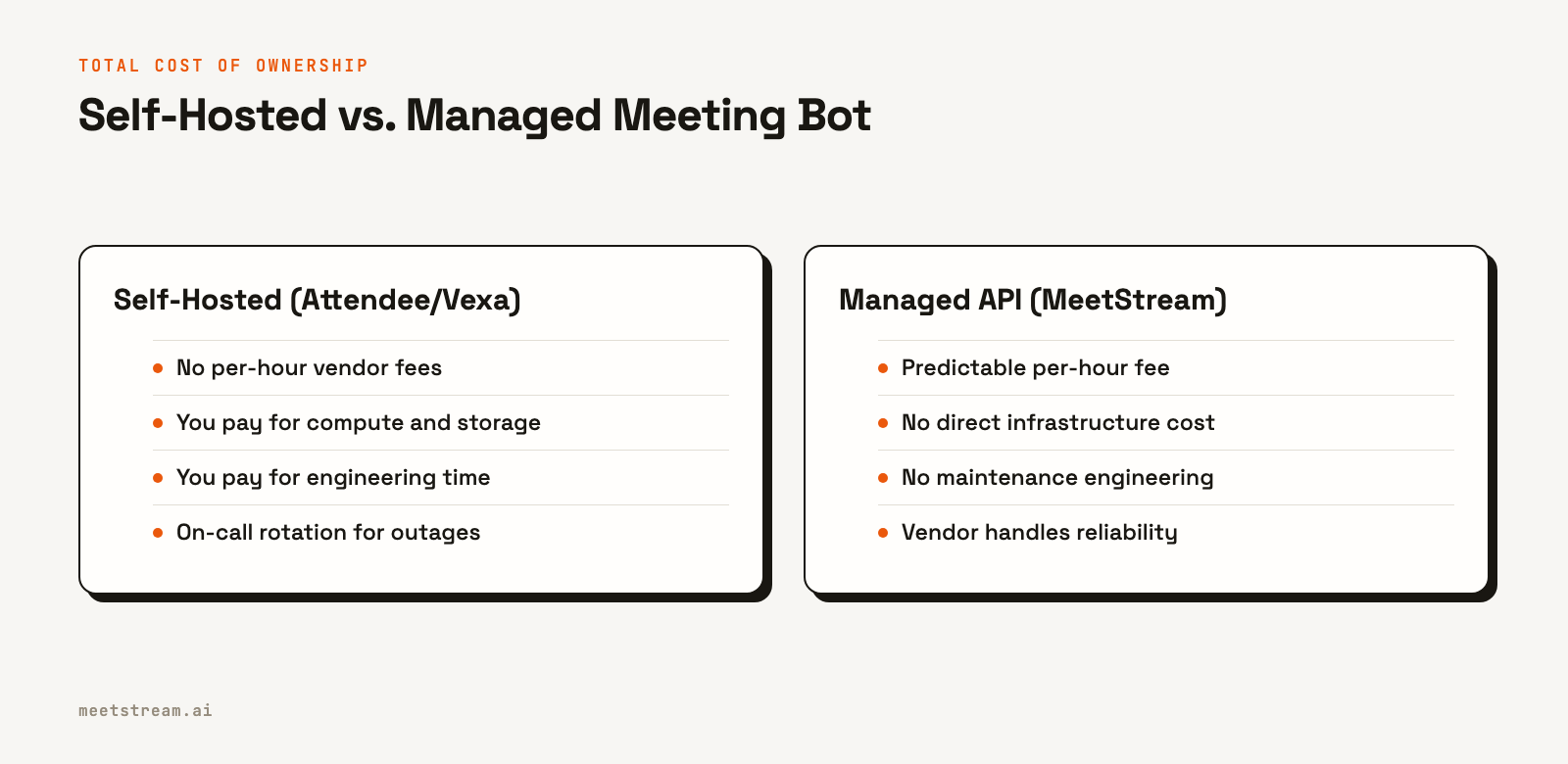
An open source meeting bot has no licensing fee at any volume. This is an advantage if per-hour metering breaks your unit economics. However, the license fee is replaced by infrastructure and operational costs. A clear view of these costs is necessary for an accurate comparison.
First, you are responsible for the browser fleet. Each concurrent meeting requires a dedicated headless browser instance. One hundred simultaneous meetings means one hundred browsers, each a potential point of failure that could lose a recording. You must build the orchestration, autoscaling, and health-checking systems to keep this fleet online.
Next is join flow maintenance. Zoom, Google Meet, and Microsoft Teams deploy UI changes frequently. Any change can break the automation that navigates pre-join screens or handles waiting rooms. With a managed provider, this is their core responsibility. When self-hosting, it becomes a recurring tax on your engineering team. For example, a project like Attendee has over 140 open issues on GitHub, many related to join logic and platform changes.
Then there is media processing. Capturing clean, per-participant audio and running accurate diarization for correct speaker labels are difficult audio engineering problems. This is especially true in meetings with background noise or multiple participants speaking at once.
Finally, you need a reliable delivery layer. This includes a webhook system that can queue events, with idempotent logic to prevent duplicate processing. To calculate the true cost, sum the compute and storage for a fleet sized to your peak concurrency, add a realistic estimate of engineering time for maintenance and on-call duties, and then divide by your monthly meeting hours. If that number is lower than a managed API's rate, self-hosting is the more economical choice.
Attendee vs. Vexa vs. Managed APIs
Attendee and Vexa are two of the most visible open source projects in this space. Attendee aims to be a full-featured meeting bot API, while Vexa focuses more specifically on transcription. Both are self-hosted and require you to manage the infrastructure. Here is how they compare to managed APIs.
| Self-Hosted (Attendee/Vexa) | MeetStream | Recall.ai | |
|---|---|---|---|
| Hosting | Self-hosted on your infra | Managed by MeetStream | Managed by Recall.ai |
| Cost Model | Infrastructure + Engineering | $0.35/hr (volume to $0.25) | $0.50/hr + add-ons |
| Core Focus | Recording and transcription | Interactive AI voice agents | Recording and data extraction |
| Real-time Audio | Requires custom build | Yes, via WebSocket | Yes, with limits |
| Bot Can Speak | Requires custom build | Yes, via API | No |
| Compliance | Your own stack's compliance | ISO 27001, GDPR, HIPAA, SOC 2 (in audit) | SOC 2, ISO 27001, HIPAA |
| Platform Support | Varies (mostly Zoom/Meet) | Zoom, Meet, Teams | Zoom, Meet, Teams, Webex, Slack |
A self-hosted bot is the right choice when compliance mandates that media cannot leave your environment. Among managed APIs, Recall.ai offers broader platform coverage and holds SOC 2 Type II and ISO 27001 and supports HIPAA compliance. MeetStream focuses on providing the infrastructure for building interactive agents, with real-time streams and the ability for bots to speak and act in meetings, at a lower base price.
When Self-Hosting Is the Right Choice
Despite the operational overhead, there are clear scenarios where running your own open source bot is the correct architectural choice.
Self-host when compliance is non-negotiable. If your customer contracts or regulatory framework state that meeting audio cannot be processed by a third party, the discussion ends there. An open source bot running inside your own VPC is the only path forward.
Self-host when you have the infrastructure skills and low call volume. A small team with deep experience in browser automation and media processing can manage a small fleet for internal tools or a low-concurrency product. The operational cost may be lower than a managed service in this case.
Self-host when you need to modify the bot's core behavior in a way no API allows. If your use case requires deep customization of the join logic or the media capture pipeline, owning the code is the only way to achieve it.
Outside of these specific cases, the economics often favor a managed service. A team adding a notetaking feature to their product should not have to become experts in operating a browser fleet.
How MeetStream Fits In
MeetStream provides a managed path that offers key benefits of self-hosting, like real-time media access, without the operational burden. It is a unified API for deploying bots and AI agents into Zoom, Google Meet, and Microsoft Teams. You provide a meeting link, and a bot joins the call.
Our focus is on being the infrastructure for agents that participate in meetings. This means providing low-latency audio streams, enabling bots to speak via text-to-speech (TTS), and allowing them to send chat messages or display images. This is the interactive layer that self-hosted solutions require you to build from scratch.
curl -X POST "https://api.meetstream.ai/api/v1/bots/create_bot" \
  -H "Authorization: Token <YOUR_API_KEY>" \
  -H "Content-Type: application/json" \
  -d '{
    "meeting_link": "<YOUR_MEETING_LINK>",
    "bot_name": "Notetaker",
    "live_transcription_required": {"webhook_url": "https://your-app.com/live"},
    "callback_url": "https://your-app.com/webhooks/meetstream"
  }'
You can get a live, speaker-attributed transcript via webhooks by setting the live_transcription_required parameter. Each event includes the speaker's name and text, allowing you to build live coaching or analysis tools. For post-call processing, our webhooks notify you when the full transcript is ready to be fetched.
MeetStream is ISO 27001 certified, GDPR and HIPAA compliant, with our SOC 2 Type 2 report currently under audit. We provide the reliability and security of a managed service while giving you the real-time access needed to build sophisticated meeting agents.
Conclusion: Choosing Your Path
Open source Recall.ai alternatives offer a path to avoid per-hour billing and maintain full data control. They are the right choice for teams with strict compliance needs or strong in-house infrastructure skills. For most other teams, the operational cost of running a browser fleet and maintaining join logic exceeds the per-hour fee of a managed API. The decision should be based on a clear analysis of total cost, including engineering time, not just the absence of a vendor fee.
If a managed API that provides real-time streams for building interactive agents fits your needs, create your first bot with MeetStream. See the full API reference at docs.meetstream.ai.
Frequently Asked Questions
What are the best open source Recall.ai alternatives?
The most common open source alternatives are self-hosted bots like Attendee and Vexa that provide a REST API to record and transcribe calls. They give you control over data and remove per-hour fees, but you are responsible for all infrastructure and maintenance.
Is it cheaper to self-host a meeting bot?
It depends on your scale and engineering capacity. Self-hosting removes vendor fees but adds costs for compute, storage, and engineering time to maintain the system. Calculate your total operational cost per hour and compare it to managed API pricing to find the true answer.
When should I self-host a meeting bot instead of using an API?
You should self-host when compliance regulations forbid sending meeting data to a third party, or when your call volume is low and your team has strong infrastructure expertise. At high volume and enterprise scale the join reliability, concurrency and on-call work grow faster than the savings, which is where a managed API earns its cost.
Do open source meeting bots support Microsoft Teams?
Vexa's README lists Google Meet, Microsoft Teams, Zoom and Jitsi, and Attendee's README leads with Zoom and Google Meet, so check each project's current platform list. Supporting a platform is not the same as keeping joins reliable as that platform changes its interface, and that upkeep is yours when you self-host. A managed meeting bot API carries that work for Zoom, Google Meet and Microsoft Teams behind one integration.
Can I get per-participant audio from an open source meeting bot?
An open source project gives you access to the raw audio, but you must build the pipeline to isolate streams for each participant and attribute them correctly. Managed APIs like MeetStream provide this as a feature, with fully isolated streams on Zoom and speaker-attributed streams on Meet and Teams.


