
Meeting Statistics 2026: Time, Volume and Productivity Data

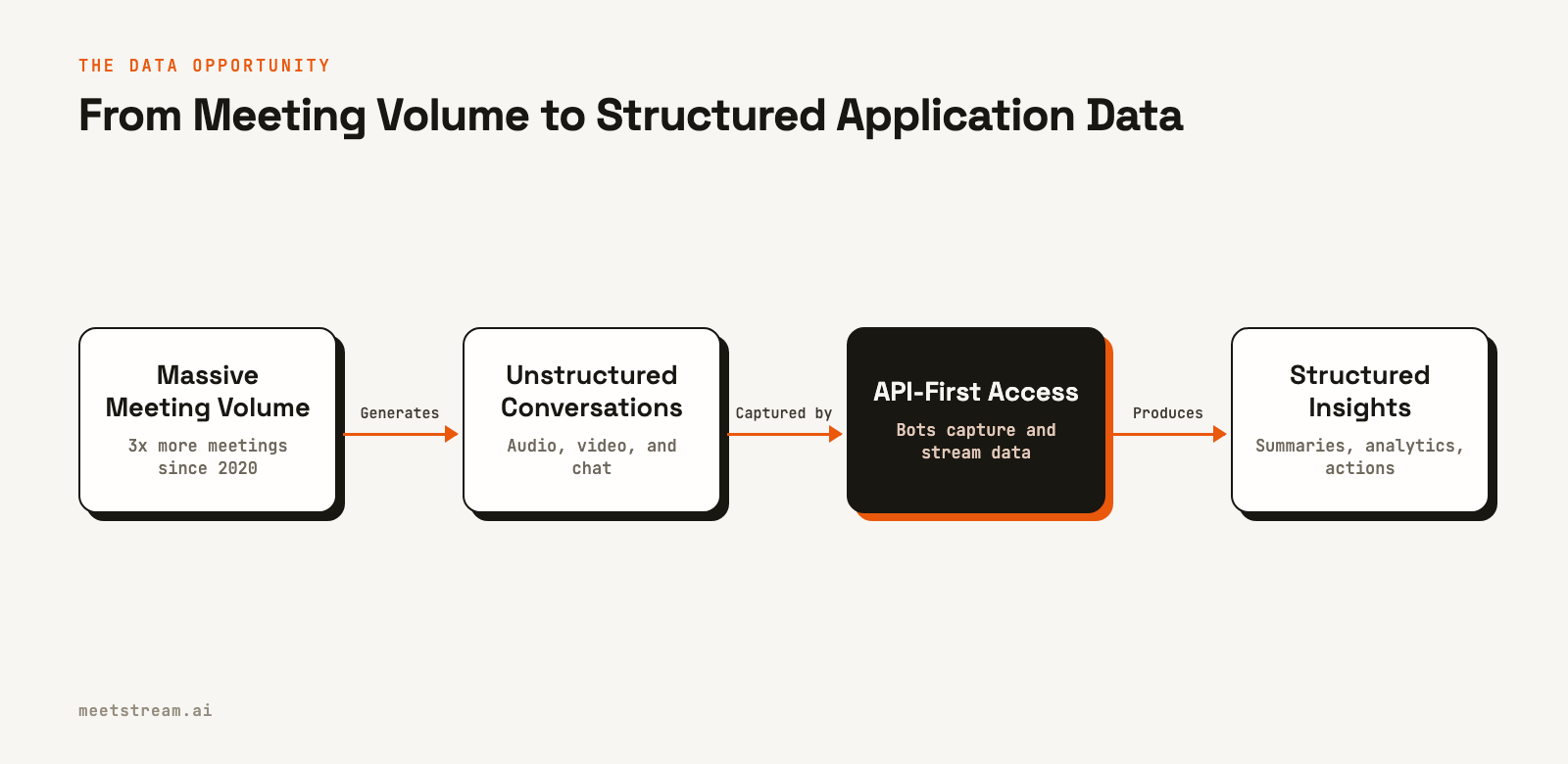
People are in three times more meetings per week than they were in early 2020. This 192% increase, reported in Microsoft's 2023 Work Trend Index ("Will AI Fix Work?", May 2023), means the volume of conversational data being generated is enormous. For developers, these meeting statistics point to a clear opportunity: most of this data is unstructured and inaccessible, waiting for tools that can capture, analyze, and act on it.
This isn't just about recording or transcription. The most valuable applications treat meetings as a real-time data source. MeetStream is designed as agent-first voice infrastructure for meetings. This approach allows you to deploy AI voice agents that join calls as active participants. They can understand the conversation, speak, and trigger workflows during the meeting, turning raw conversation into structured events.
The core problem is that while meeting volume has exploded, the tools to manage the resulting information have not kept pace. Manual note-taking and follow-ups are inefficient at scale. The solution is to treat meetings as a programmable data source, available through an API just like any other business system.
This article breaks down the key meeting statistics from recent studies and our own platform data. We will cover how much time is spent in meetings, when they happen, and what this data means for developers building the next generation of meeting-connected applications. Let's get into it.
How Much Time Do We Spend in Meetings?
The amount of time employees spend in meetings has grown significantly. Since February 2020, the average Microsoft Teams user saw a 252% increase in their weekly meeting time, according to Microsoft's 2022 Work Trend Index ("Great Expectations", March 2022). This expansion of meeting time is a direct result of the shift to remote and hybrid work models.
More recent data shows that employees spend 57% of their time communicating through meetings, email, and chat, leaving only 43% for creation and focused work ("Will AI Fix Work?", May 2023). Meetings alone take up 23% of the workday. For developers, this highlights a clear pain point. Applications that can make this large time investment more productive, either by improving the meeting itself or by automating post-meeting tasks, have a large potential market.
At MeetStream, we see this in our own platform data. Having processed over 1,000,000 meeting minutes, a primary use case is building tools that summarize long discussions and extract key information. This directly addresses the need to recover focus time lost to inefficient meetings, which employees rank as the top productivity disruptor.
Meeting Frequency and Scheduling Patterns
The data also reveals changes in how meetings are scheduled. The total number of weekly meetings increased by 153% between March 2020 and February 2022 ("Great Expectations", March 2022). This indicates a shift towards more frequent, and often shorter, interactions. In fact, meetings under 15 minutes now account for 60% of all meetings on Teams.
A significant portion of these are unscheduled. Ad hoc calls make up 64% of all Teams meetings, an 8% increase over two years. A 2025 Microsoft report ("Breaking down the infinite workday", June 2025) confirms this, finding 57% of meetings are ad hoc calls without a calendar invite. For developers building meeting bot API applications, this is a critical insight. Your service cannot rely solely on calendar integrations. It needs the ability to join a meeting instantly with just a URL.
Scheduling is also highly concentrated. Half of all meetings occur between 9-11 am and 1-3 pm, with Tuesday being the busiest day (23% of weekly meetings). This creates intense peaks in demand for meeting infrastructure. Any platform you build on must be able to scale to handle thousands of concurrent sessions during these peak hours without performance degradation.
The Developer Opportunity in Meeting Data
The sheer volume of meetings creates a large, constantly refreshing dataset of unstructured information. Every discussion, decision, and customer interaction is a potential input for an automated workflow. The opportunity for developers is to build the software that structures this data and makes it useful.
This starts with reliable data capture across all major platforms. Most companies use a mix of Zoom for sales, Microsoft Teams for internal work, and Google Meet for external collaboration. Building and maintaining separate integrations for each is a significant engineering effort. A unified API that handles the complexities of joining calls on each platform is the necessary foundation.
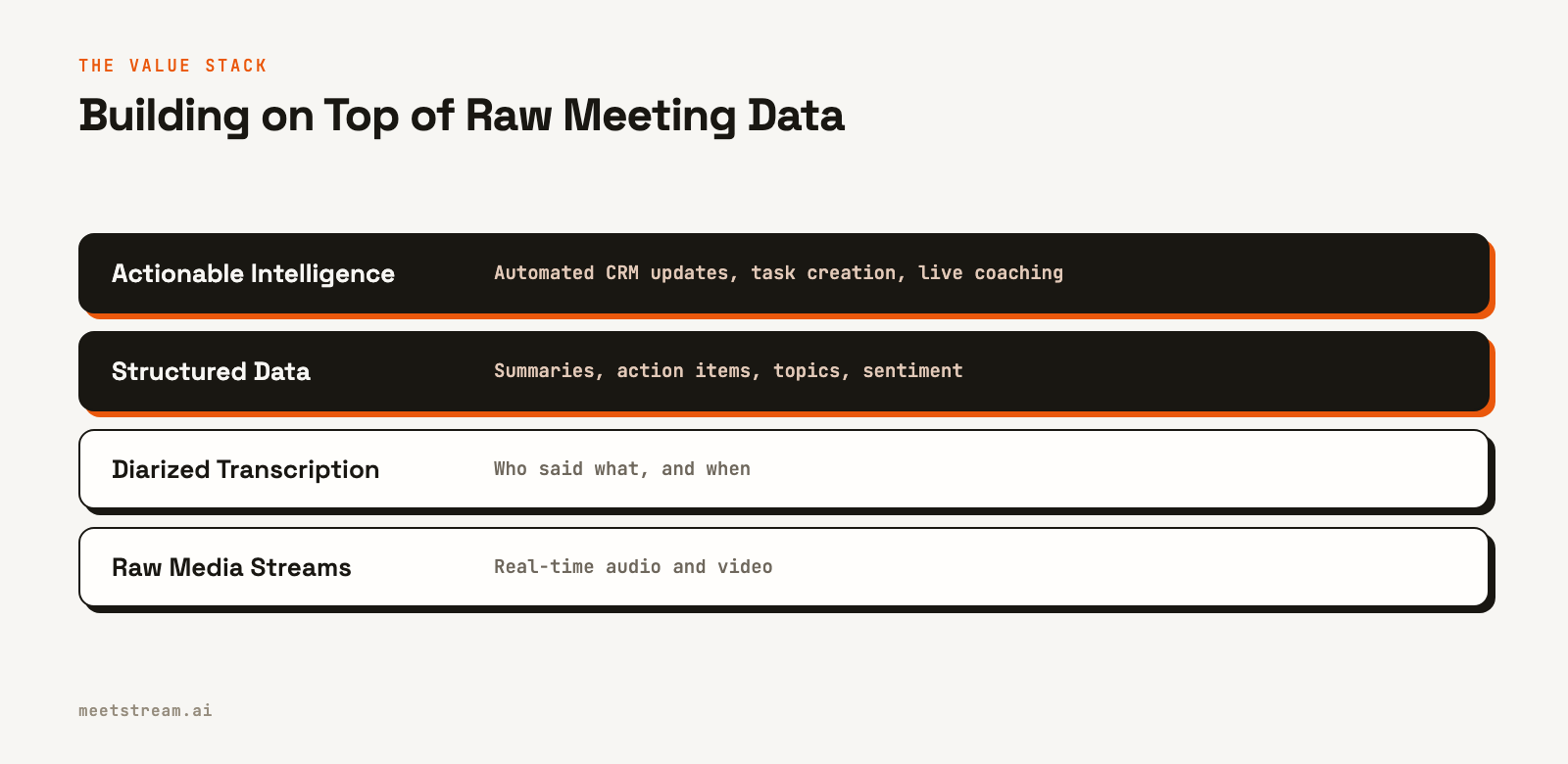
Once you have the data, you can build applications that move up the value stack. This involves processing raw media into more valuable forms. For example, a sales coaching tool might use a real-time audio stream to provide live feedback, while an AI notetaker would use a post-call transcript to generate a summary and extract action items. The goal is to turn conversations into structured, actionable intelligence.
Common Use Cases Driven by the Data
The meeting statistics directly inform what kinds of applications are most valuable. With employees citing inefficient meetings and information searching as major productivity blockers, tools that automate these tasks are in high demand.
AI Note-Takers and Summarizers: With a 252% increase in weekly meeting time, manual note-taking is no longer scalable. Automated notetakers use a full, speaker-labeled transcript to generate summaries, identify decisions, and extract action items. This structured output can be sent to project management tools, saving hours of manual work.
Sales Conversation Intelligence: Sales calls are high-value events. A conversation intelligence API allows a bot to join a sales demo on Zoom, analyze the discussion for competitor mentions or buying signals, and automatically update the CRM with call notes and outcomes. This automates data entry and provides managers with analytics on sales performance.
Internal Meeting Analytics: As meeting volume grows, so does the need to understand it. By analyzing metadata across all internal meetings on Teams and Meet, companies can build dashboards to track metrics like talk-time balance, topic frequency, and cross-departmental collaboration. This provides insight into how work actually gets done.
Technical Challenges to Address
Accessing and processing live meeting data is a complex infrastructure problem. The first challenge is reliably joining a call. Each platform has its own authentication and SDKs. For example, joining a Zoom meeting programmatically requires handling their On Behalf Of (OBF) token flow, which is a different process from joining a Google Meet call.
Once inside, capturing clean audio is the next obstacle. Participants use various microphones and have different network conditions. While some platforms like Zoom provide fully isolated audio streams per participant, others like Google Meet and Teams provide a mixed stream with speaker attribution. Your application logic needs to handle these different audio formats.
Finally, processing this data with low latency is critical for real-time applications. Whether you are using webhooks or WebSockets for data delivery, the system must be resilient. Any delay in a live coaching application or an interactive voice agent can negatively impact the user experience.
How MeetStream Provides Structured Meeting Data
MeetStream is an API platform built to solve these infrastructure challenges. We provide a single, unified API to deploy bots and AI agents into Zoom, Google Meet, and Microsoft Teams. You provide a meeting URL, and our platform handles the complexity of joining the call, capturing the media, and keeping the bot connected.
Our infrastructure is designed for developers building interactive applications. You can get a low-latency stream of audio and video, or receive live transcripts via webhook. For post-call workflows, we send an event when the meeting ends and the full, speaker-diarized transcript is ready. This allows you to build on top of reliable meeting data without managing a fleet of bots yourself.
This example shows how to send a bot to any meeting to get a transcript. The same API call works for all supported platforms.
curl -X POST "https://api.meetstream.ai/api/v1/bots/create_bot" \
  -H "Authorization: Token <YOUR_API_KEY>" \
  -H "Content-Type: application/json" \
  -d '{
    "meeting_link": "<YOUR_MEETING_LINK>",
    "bot_name": "Notetaker",
    "callback_url": "https://your-app.com/webhooks/meetstream",
    "recording_config": {
      "transcript": {
        "provider": {
          "meetstream": {}
        }
      }
    }
  }'
By providing the foundational layer for data capture, MeetStream lets you focus on building your application's core logic.
Conclusion
The meeting statistics from the last few years show a clear and lasting shift in how work is done. The sustained high volume of meetings has created a large and valuable dataset that is, for most companies, completely untapped. For developers, the opportunity is to build the tools that structure this data and automate workflows. A unified API for meeting access is the foundational layer for this new category of software.
Get started free at meetstream.ai.
Frequently Asked Questions
How many more meetings are people attending?
People are in three times as many Microsoft Teams meetings per week as they were in February 2020, a 192% increase. The total number of weekly meetings grew by 153% in the first two years of the shift to hybrid work.
What is the average length of a meeting?
While overall meeting time has increased, the trend is towards shorter, more frequent meetings. Data shows that 60% of all meetings on Microsoft Teams are now less than 15 minutes long.
What percentage of meetings are unplanned?
A majority of meetings are now ad hoc. Different studies report that between 57% and 64% of meetings are unscheduled calls made without a formal calendar invitation, highlighting the need for tools that can join calls instantly.
How much of the workday is spent in meetings?
Employees spend about 23% of their workday in meetings. When combined with email (15%) and chat (19%), communication-related tasks account for 57% of the total workday, according to a 2023 Microsoft survey.
What is the biggest productivity challenge related to meetings?
In a survey of 31,000 workers, inefficient meetings were ranked as the top productivity disruptor. This is followed by the struggle to find necessary information, indicating a strong need for tools that can effectively summarize and index meeting content.


