
The Future of Meeting Bots: AI Agents and Real-Time Intelligence

Meeting bots are no longer just passive recorders. The most interesting work in this space has shifted from post-call transcription to building active, AI-driven participants that can listen, understand, and act in real time. This change moves the bot from a simple data-capture tool into a genuine agent that can interact with the meeting as it happens.
This evolution is driven by the convergence of three key technologies: reliable, low-latency media streaming, the accessibility of powerful large language models (LLMs), and unified APIs that abstract away the complexity of individual meeting platforms. The result is that a weekend project can now achieve what was a multi-year infrastructure build just a few years ago. We have processed over a million meeting minutes at MeetStream, and we see this pattern firsthand.
The new paradigm is the AI meeting agent. Unlike a traditional bot that delivers a summary hours after a call, an agent operates mid-meeting. It can answer questions, update a CRM, create a support ticket, or even speak, all triggered by the live conversation. This is the core of the future of meeting bots.
We will look at the architectural changes this requires, the new capabilities that emerge, and the practical challenges of building these systems. Let's get into it.
From Passive Recorders to Active Agents
For years, the primary job of a meeting bot was to join a call, record audio, and then send that audio to a transcription service. The final output, a block of text, would arrive in a webhook payload or email long after the meeting ended. This was useful for record-keeping but had no impact on the meeting itself. The bot was a silent observer.
The future of meeting bots is participatory. An active agent connects to a real-time stream of the meeting's audio, processes it through a speech-to-text (STT) engine, and feeds the resulting text into an LLM, all within milliseconds. This allows the agent to maintain a live, evolving understanding of the conversation. It knows who is speaking, what they are saying, and the context of the discussion up to that point.
This shift from passive to active fundamentally changes what's possible. Instead of just creating a historical record, the bot can influence the meeting's outcome. It becomes a tool for the participants to use during the call, not just a service they benefit from afterward. This distinction is the difference between a simple transcription tool and a true AI meeting agent.
The Core Architectural Shift to Real-Time
The traditional, post-call architecture is a simple, linear pipeline. The bot joins, records an audio file, and leaves. Once the meeting is over, it uploads the file to a transcription provider. When the transcription is complete, another process might run NLP models to extract a summary or action items. The key characteristic is that every step is asynchronous and happens after the fact.
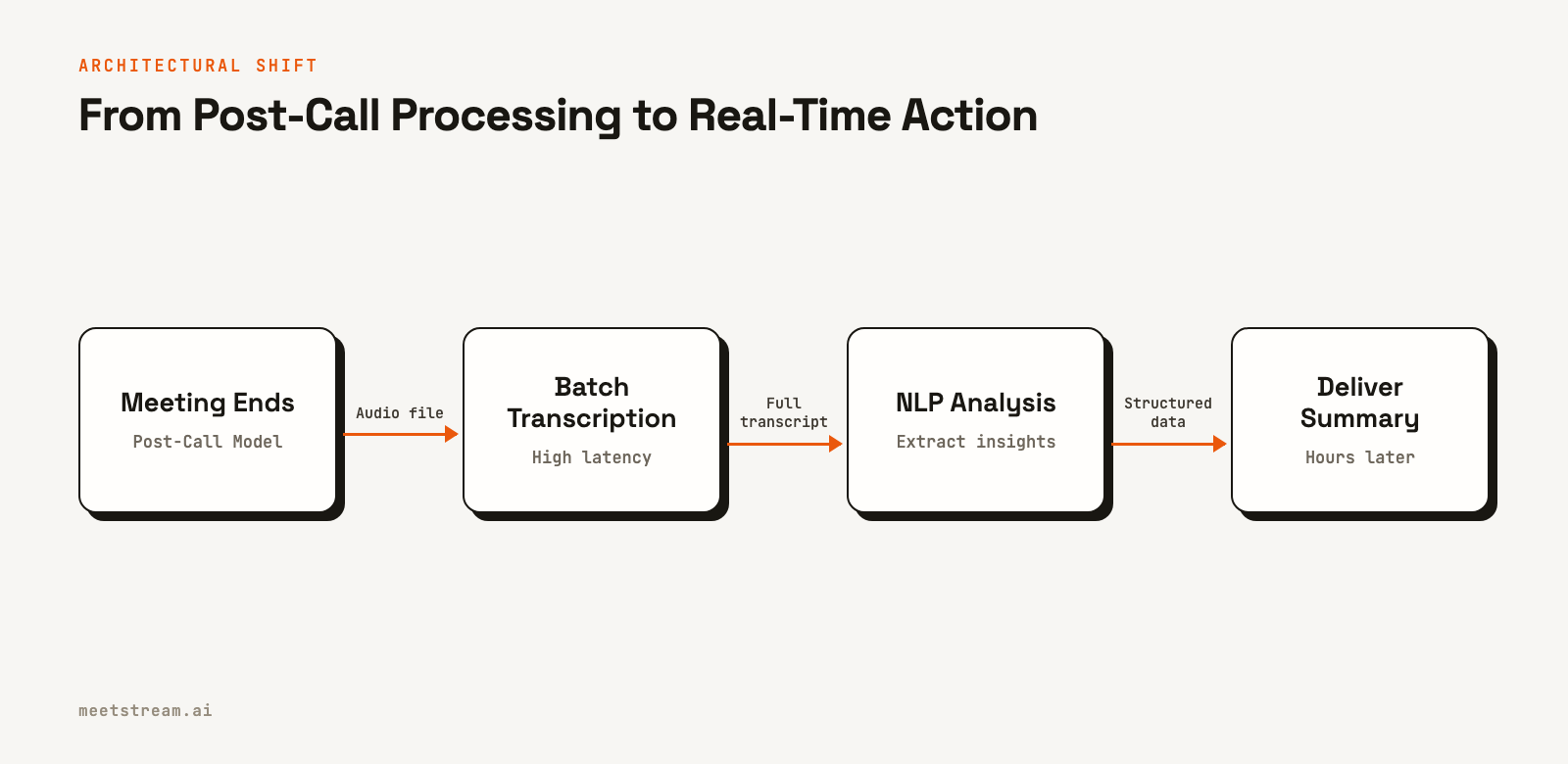
Building an active agent requires a completely different architecture built around real-time data flow. The foundation is a persistent WebSocket connection that streams audio from the meeting to your application with minimal delay. This live audio is fed into a streaming transcription service, which returns text as it's spoken. This text, along with speaker labels, is then passed to a stateful application that often involves an LLM.
This new model is a continuous loop, not a one-way pipeline. The agent's output can be fed back into the meeting. For example, after identifying an action item, the agent can use an API to post a confirmation message in the meeting chat or use text-to-speech (TTS) to ask for clarification. This requires a bidirectional command and control channel, another key piece of the real-time infrastructure.
Key Capabilities of Modern Meeting Agents
This real-time architecture unlocks a new set of capabilities that were impossible with post-call processing. An agent is not just a listener, but a participant with its own tools and abilities. These capabilities are built on a stack of technologies, from the underlying infrastructure to the intelligence and action layers.
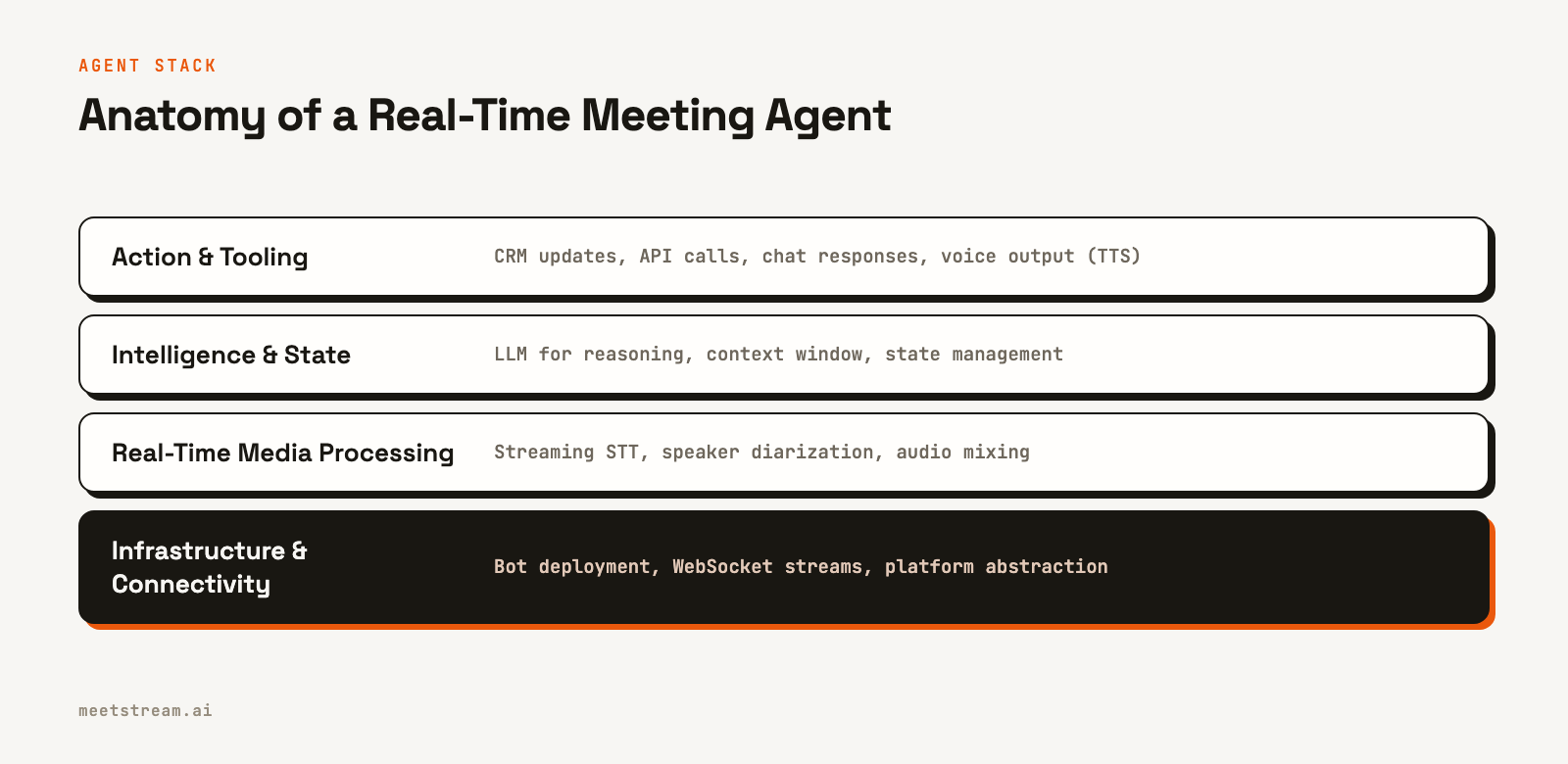
The core capabilities include:
Real-time conversational understanding: By using a streaming STT service, the agent gets a live feed of the conversation. When combined with an LLM, it can track topics, identify questions, recognize sentiment, and understand the context of the discussion as it unfolds. This is the foundation for all other agentic behavior.
In-meeting actions: A true agent can act. This can be as simple as posting a message in the meeting chat via an API call. More advanced agents can speak using a TTS service to answer a question or prompt the team. They can also perform visual actions, like changing their video avatar to an image or a GIF to provide information non-verbally.
External tool use: The most powerful agents can connect to external systems. When a user mentions a bug, the agent can create a Jira ticket. When a customer's name is mentioned, it can pull up their record from Salesforce. This is often accomplished by giving an LLM access to a specific set of APIs, allowing it to trigger real-time actions in other software.
Real-World Implementation Patterns
These capabilities are not just theoretical. Teams are actively building AI agents that use these patterns to solve specific business problems. The common thread is using the live conversation as a trigger for an automated workflow.
For example, a sales coaching agent can listen to a discovery call in real time. When it detects a customer objection related to pricing, it can silently push a notification with relevant counter-points and data to the sales representative's screen. This provides immediate support without interrupting the conversational flow.
In a technical context, a developer team could use an agent during their daily stand-up. When a developer says, "I'll create a ticket for that," the agent can parse the statement, ask for a title and description, and then use the Linear or GitHub API to create the issue. The confirmation and link are then posted back to the meeting chat.
Another pattern is for interview intelligence. An agent can join a candidate interview, listen for mentions of specific technologies or skills from their resume, and automatically bring up relevant projects from their portfolio or GitHub profile for the interviewer to see. This makes the interview more dynamic and data-driven.
Tradeoffs and Technical Challenges
Building these real-time agents introduces new technical challenges that don't exist in a post-call world. The biggest obstacle is managing latency. For an agent's response to feel natural, the "time to first token" for its spoken or text response must be very low, ideally under a second. This requires optimizing every step of the process, from audio buffering to STT and LLM inference time.
State management is another significant challenge. A meeting can last for an hour or more, and an agent needs to maintain context throughout. Deciding what to keep in the LLM's context window, how to summarize previous parts of the conversation, and how to handle long periods of silence are all difficult engineering problems. The agent must remember what was said at the beginning of the call to understand a comment made 45 minutes later.
Finally, ensuring reliability and accuracy is critical. An agent that hallucinates or misinterprets a key decision is worse than no agent at all. This requires careful prompt engineering, reliable error handling, and often a "human in the loop" design pattern where the agent suggests an action and waits for a user to confirm it before executing.
How MeetStream Enables Agentic Bots
Building the foundational infrastructure for these agents is a significant undertaking. MeetStream provides the core components needed to deploy, connect, and control bots across Zoom, Google Meet, and Microsoft Teams with a single meeting bot API. Our platform is designed specifically for building agentic, real-time applications.
We provide low-latency real-time audio streaming over WebSockets, giving you direct access to the conversation as it happens. You can also establish a bidirectional control channel that lets your application send commands back to the bot, such as sending a chat message or playing audio into the meeting. This provides the core feedback loop required for an active agent.
Here is how you can deploy a bot to a meeting and configure it to send you webhooks for key events and provide a post-call transcript.
curl -X POST "https://api.meetstream.ai/api/v1/bots/create_bot" \
  -H "Authorization: Token <YOUR_API_KEY>" \
  -H "Content-Type: application/json" \
  -d '{
    "meeting_link": "https://meet.google.com/abc-defg-hij",
    "bot_name": "Notetaker",
    "callback_url": "https://your-app.com/webhooks/meetstream",
    "recording_config": {
      "transcript": {
        "provider": {
          "meetstream": {}
        }
      }
    }
  }'
This API call handles the complexity of joining the meeting, establishing the media streams, and providing you with simple, reliable callbacks, letting you focus on building the agent's intelligence.
Conclusion
The future of meeting bots is a clear evolution from passive data collection to active, real-time participation. The most valuable meeting applications will be those that act as intelligent agents, assisting participants during the live conversation. This requires a fundamental architectural shift towards low-latency streaming and a new set of tools for building stateful, interactive experiences. While the technical challenges are real, the underlying infrastructure is now mature enough to make building these agents accessible to any developer.
See the full API reference at docs.meetstream.ai.
Related guides
Frequently Asked Questions
What is the biggest change in meeting bot technology?
The most significant change is the shift from passive, post-call transcription to active, real-time participation. New bots are AI agents that can understand and act during the meeting, not just create a record of it afterward.
How does real-time intelligence change a meeting bot's role?
Real-time intelligence allows a bot to detect and act on events as they happen. For example, it can identify a question and instantly pull up a relevant document, or hear an action item and immediately create a task in a project management tool.
What infrastructure is needed to build an AI meeting agent?
Building an agent requires a stateful session store to track context, low-latency WebSockets for streaming audio and control, fast inference endpoints for STT and LLM services, and an action bus to route agent outputs to other systems.
Will AI meeting agents replace human note-takers?
For structured meetings like sales calls or daily stand-ups, agents can be more consistent and complete than human note-takers. For creative or highly nuanced discussions, human judgment is still essential. The best approach often combines bot-generated structure with human review.


