
SOC 2, GDPR and HIPAA for AI Meeting Bots: A Compliance Primer

Building an AI meeting bot involves more than just capturing audio. Every meeting your bot joins can contain sensitive business strategies, personal data, or even protected health information. This makes compliance with frameworks like SOC 2, GDPR, and HIPAA a core engineering requirement, not a legal afterthought. These standards govern how you handle data, secure your systems, and respect user privacy.
MeetStream is an agent-first voice infrastructure platform for meetings, designed to let developers deploy AI agents that can join calls, listen, and act. We've processed over 1,000,000 meeting minutes, and a significant part of our work is providing the secure foundation for these applications. This means handling encryption, data residency, and access controls at the infrastructure level, giving you the building blocks for a compliant product.
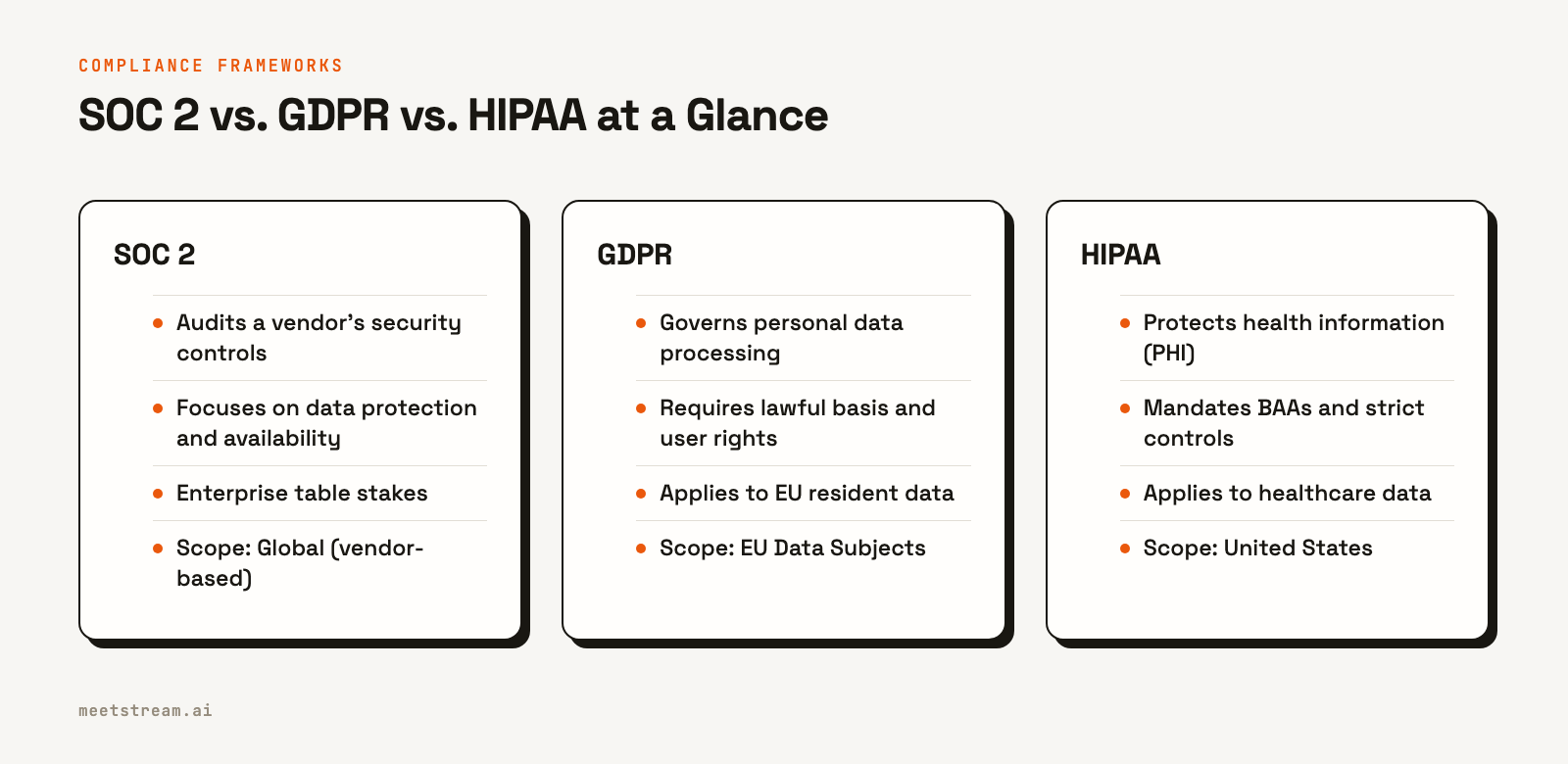
Each framework has a different focus. SOC 2 audits a service provider's operational security. The General Data Protection Regulation (GDPR) defines rules for processing the personal data of EU residents. The Health Insurance Portability and Accountability Act (HIPAA) sets strict standards for handling Protected Health Information (PHI) in the United States.
This primer explains what each of these frameworks requires for AI meeting bots and shows how to implement the necessary technical controls.
Why Compliance Is a Core Requirement for Meeting Bots
AI meeting bots are data processors. They capture conversations, identify speakers, and generate transcripts that become a permanent record. This data is often highly sensitive, containing everything from unannounced product plans to confidential client information. Without a clear compliance strategy, you risk significant regulatory fines, loss of customer trust, and barriers to enterprise adoption.
For developers, thinking about compliance early simplifies architecture. Building on a platform with foundational security certifications means you can focus on your application's logic instead of reinventing security primitives. It also makes it easier to answer security questionnaires from enterprise customers, who will always ask about your data handling practices.
SOC 2: Auditing Your Security Controls
SOC 2 is a compliance framework developed by the American Institute of CPAs (AICPA) that specifies how organizations should manage customer data. It is based on five "trust services criteria": security, availability, processing integrity, confidentiality, and privacy. For a meeting bot API, a SOC 2 report demonstrates to customers that the vendor has the necessary controls in place to protect their data.
There are two types of SOC 2 reports. A Type I report describes a vendor's systems and whether their design is suitable to meet relevant trust principles at a single point in time. A Type II report details the operational effectiveness of those systems over a period of time, typically 6-12 months. For enterprise customers, a SOC 2 Type II report is often a non-negotiable requirement for any software vendor.
Auditors will examine access controls for stored recordings, encryption methods for data in transit and at rest, your incident response plan, and the audit logs your system generates. They need to see that you can prove who accessed what data, and when.
GDPR: Managing EU User Data
The GDPR applies to any organization that processes the personal data of individuals residing in the European Union. Because a person's voice and name are considered personal data, any meeting bot recording EU residents falls under its scope. The penalties for non-compliance are severe.
Three key GDPR principles directly affect how you build a meeting bot:
- Lawful Basis for Processing: You must have a valid legal reason to record and process the data. This is typically either explicit consent from the participants or a "legitimate interest" that is documented and balanced against the individual's privacy rights.
- Data Subject Rights: EU residents have the right to access, rectify, and erase their personal data (the "right to be forgotten"). Your application must have a mechanism to fulfill these requests, which means you need to be able to find and delete a specific user's data from your systems.
- Data Localization: GDPR has strict rules about transferring personal data outside the EU. To simplify compliance, it's often best to process and store data from EU users within an EU data center.
In practice, this means your bot should announce its presence and purpose upon joining a call, and you must have a clear, automated policy for data retention and deletion.
HIPAA: Protecting Health Information
When a meeting bot is used in a healthcare context, such as a telehealth consultation or a clinical trial discussion, it may handle Protected Health Information (PHI). This brings it under the scope of HIPAA, a US law that governs the privacy and security of medical information.
HIPAA is stricter than other frameworks. Its Security Rule calls for technical safeguards: encryption of PHI at rest and in transit (HHS points to NIST guidance, which in practice means AES for stored data and current TLS for data on the wire), access controls, and audit trails of every access to PHI. A critical requirement is the Business Associate Agreement (BAA), a legal contract that must be in place between a healthcare provider (the "Covered Entity") and any of its vendors (the "Business Associates") that handle PHI. Without a signed BAA from your infrastructure provider, your application cannot be HIPAA compliant.
A Practical Implementation Checklist
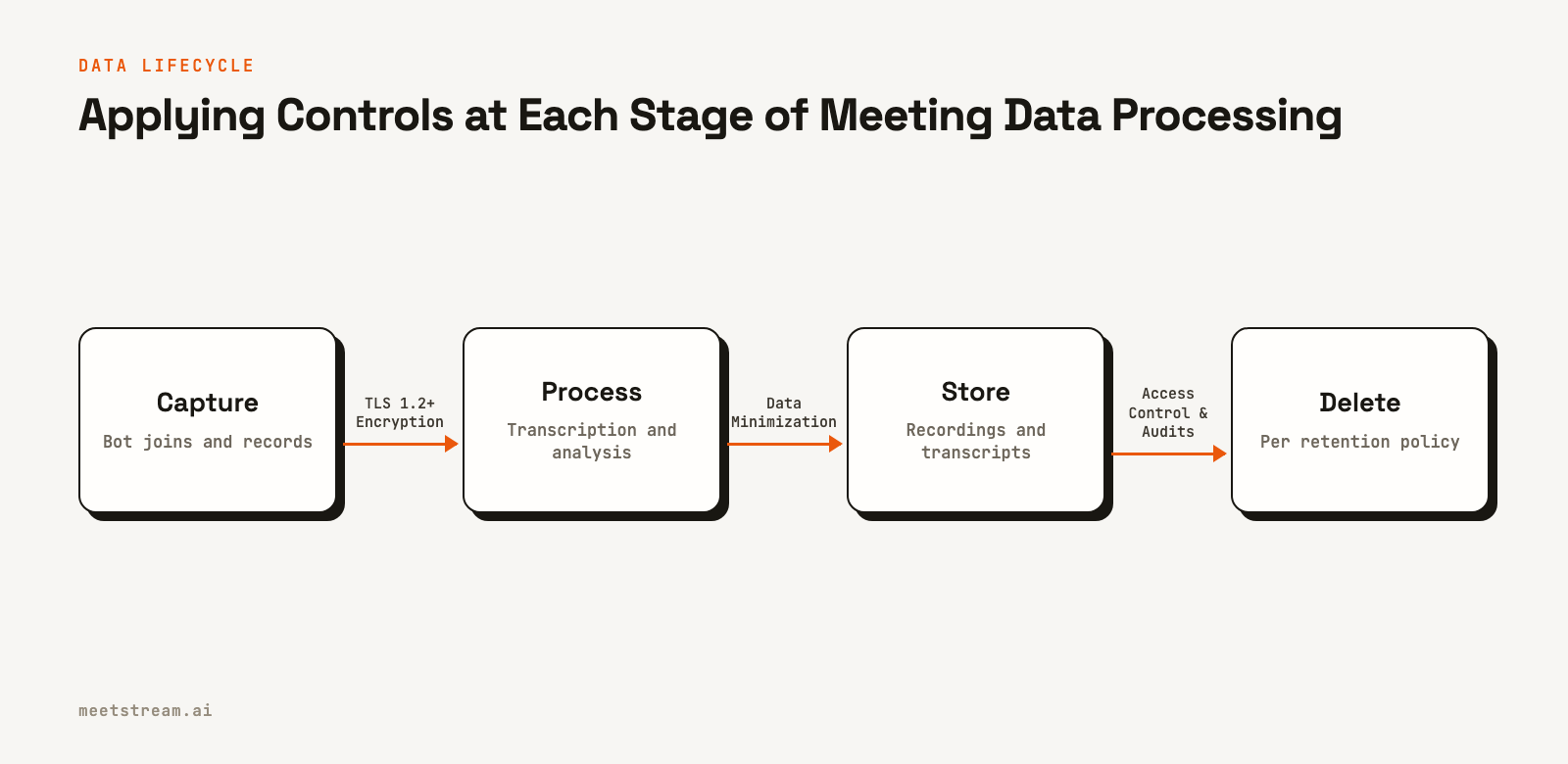
Turning these requirements into code involves a few key practices. These controls are frequently examined in SOC 2 audits and GDPR assessments for meeting bot applications.
- Implement Data Minimization. Only request the data your application needs. If you only need a transcript, don't request video. This is a core principle of GDPR and reduces the scope of data you are responsible for securing.
- Automate Retention Policies. Do not rely on manual deletion. Configure data lifecycle policies programmatically. For example, you can set a maximum retention period when a bot is created and ensure data is automatically deleted after that time. Document this policy for auditors.
- Build Programmatic Consent Flows. When a bot joins a meeting, it should immediately post a message in the chat identifying itself and linking to your privacy policy. This creates a record of disclosure. You can use the
bot_messageparameter in an API call to automate this. - Maintain Detailed Audit Logs. Every action that accesses a recording or transcript must be logged. The log should include the user ID, the resource ID, the timestamp, the source IP, and the action performed. These logs are essential for demonstrating compliance and investigating any potential incidents.
How MeetStream Provides Compliance Building Blocks
MeetStream's infrastructure is designed to provide the secure foundation for building compliant AI meeting applications. We are ISO 27001 certified, and our SOC 2 Type 2 report is currently under audit. For healthcare applications, MeetStream is HIPAA compliant and we sign BAAs with our customers.
Our platform provides several key features to help you meet your obligations:
- Data Residency: You can choose to process and store all your data in either US or EU regions to meet GDPR and other data localization requirements.
- Per-Bot Retention: You can programmatically set a data retention period for each bot you create. When the period expires, MeetStream automatically deletes the associated data and sends a
data_deletionwebhook to confirm it. - Access Controls: Every API call is authenticated with your API key, and all data, including recordings and transcripts, is encrypted in transit and at rest.
Here is an example of creating a bot with a 30-day retention policy and a welcome message for consent disclosure:
curl -X POST "https://api.meetstream.ai/api/v1/bots/create_bot" \
  -H "Authorization: Token <YOUR_API_KEY>" \
  -H "Content-Type: application/json" \
  -d '{
    "meeting_link": "<YOUR_MEETING_LINK>",
    "bot_name": "Compliance Bot",
    "bot_message": "Hello, this bot is joining to transcribe the meeting. For more information, please see our privacy policy at https://your-app.com/privacy",
    "callback_url": "https://your-app.com/webhooks/meetstream",
    "recording_config": {
      "retention": {"type": "timed", "hours": 720}
    }
  }'
While MeetStream provides these infrastructure-level controls, your application is still responsible for managing user-level access control, obtaining consent, and maintaining your own audit logs. A compliant system is a partnership between your application logic and your infrastructure provider.
Conclusion
Building compliant AI meeting bots requires treating security and privacy as core features. Frameworks like SOC 2, GDPR, and HIPAA provide the blueprint for protecting sensitive data and building trust with users. By understanding their requirements and using infrastructure with built-in controls for data residency, retention, and encryption, you can focus on building your application's unique features on a secure and scalable foundation.
For a detailed overview of our security practices, see the Security and Compliance page on our website.
Related guides
- Meeting Bot API for Zoom, Google Meet & Teams
- Google Meet Bot API
- Zoom Meeting Bot API
- Microsoft Teams Bot API
- AI Voice Agents for Zoom, Meet and Teams
Frequently Asked Questions
What GDPR requirements apply to meeting recording bots?
Under GDPR Article 13, you must inform participants at the time of data collection. For meeting bots, this means the bot should announce itself at join and link to a data processing notice. You also need a lawful basis for processing, typically legitimate interests or explicit consent, and must honor deletion requests within 30 days.
How does SOC 2 Type II apply to a meeting bot API provider?
SOC 2 Type II requires the provider to demonstrate that security controls were operating effectively over a minimum 6-month observation period. For meeting bots, auditors specifically examine access controls on recording storage, encryption in transit and at rest, incident response procedures, and audit logging of API access.
What makes a meeting recording HIPAA-compliant?
HIPAA compliance requires a Business Associate Agreement (BAA) with your recording infrastructure provider, encryption of PHI at rest and in transit that follows NIST guidance, role-based access controls, and an audit trail logging every access to a recording. Automatic deletion after the retention period is also required.
Do meeting participants need to consent before a bot joins?
Requirements vary by jurisdiction. In two-party consent states in the US like California and Florida, all participants must be informed before recording begins. In GDPR jurisdictions, explicit consent or a legitimate interest assessment is required. Best practice is to have the bot announce its presence immediately upon joining, regardless of local law.


